
Rhode Island Red chickens are one of those breeds almost everyone notices sooner or later. Deep red feathers, yellow legs, a sturdy body, and a look that says, “Yep, I belong on a farm.”
And they really do.
The Rhode Island Red chicken was built to be useful. Eggs, meat, free-range life, backyard flocks these birds can handle a bit of everything. They are not tiny, delicate chickens that need constant babying. A healthy Rhode Island Red is usually pretty hardy, active, curious, and good at finding food around the yard.
A Rhode Island Red hen can lay a solid number of brown eggs each year. Good laying strains may reach around 250 eggs or even more, though heritage and exhibition-type birds may lay less. Rhode Island Red roosters are bigger, heavier, and sometimes much more confident than the hens. Standard weights are about 8.5 pounds for an adult cock and 6.5 pounds for an adult hen.
These chickens started in New England, mainly Rhode Island and nearby Massachusetts, during the 1800s. Farmers wanted one bird that could give them eggs, meat, strength, and decent survival in rough weather. That practical farm goal shaped the breed we know today.
|
Origin |
Rhode Island and Massachusetts, USA |
|
Main Use |
Eggs and meat |
|
Hen Weight |
About 6–6.5 lb |
|
Rooster Weight |
About 8–8.5 lb |
|
Egg Color |
Brown |
|
Egg Size |
Medium to large |
|
Egg Production |
Often around 200–300 eggs yearly, depending on strain |
|
Feather Color |
Rich red to dark mahogany |
|
Skin |
Yellow |
|
Temperament |
Active, confident, often friendly |
|
Climate |
Hardy, including cold weather |
|
Growth |
Moderate, with young birds maturing over several months |
|
Lifespan |
Often around 5–10 years with good care |
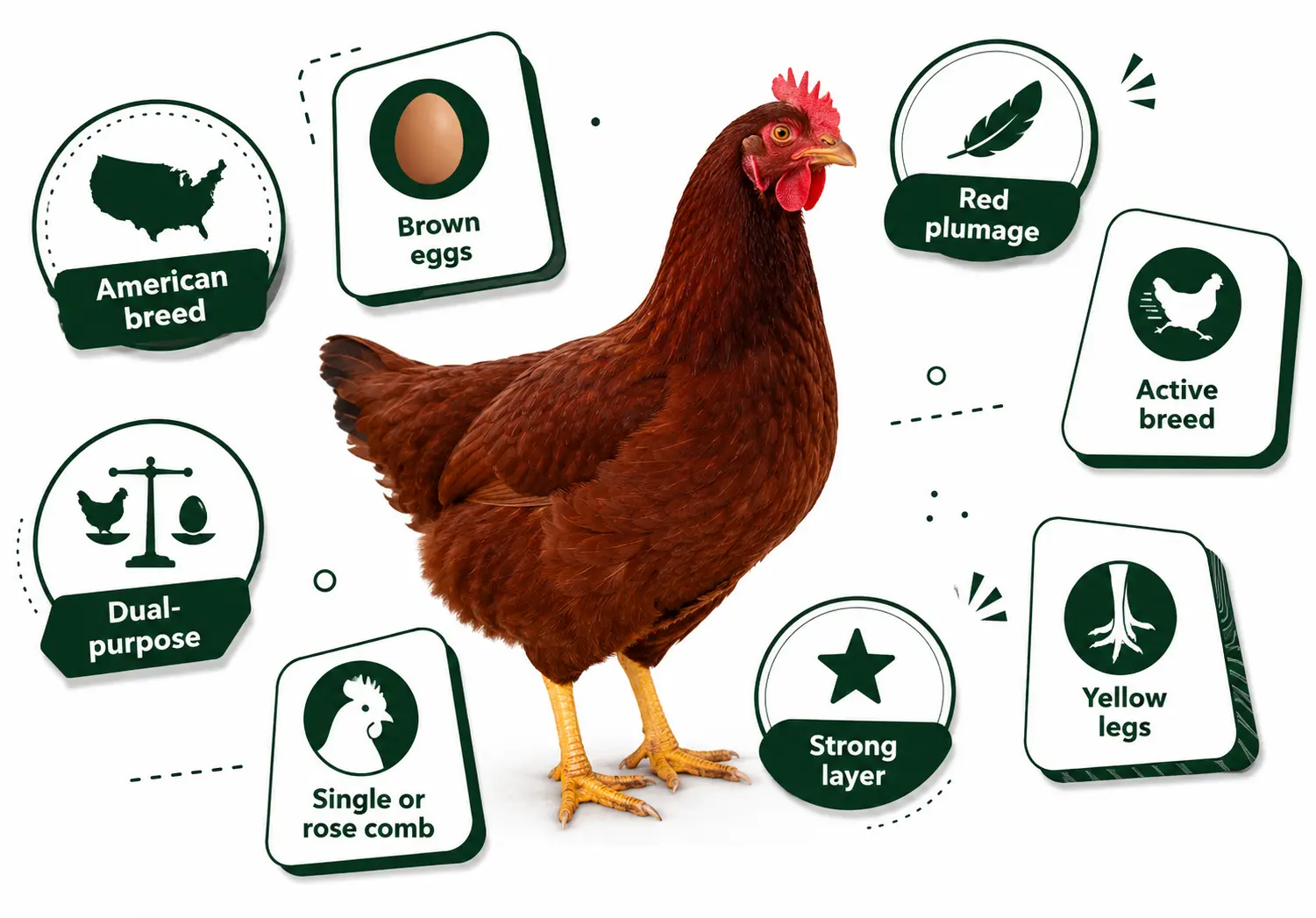
A Rhode Island Red is an American dual purpose chicken breed.
Dual purpose sounds fancy, but the idea is simple: the bird can be useful for both eggs and meat.
That was a big deal when the breed was developed. Farmers didn’t want a chicken that was amazing at one thing and useless at everything else. They wanted a solid farm bird.
Rhode Island Reds became known as reliable layers, decent table birds, active foragers, and fairly tough chickens. They were especially useful on family farms where birds had to handle changing weather, simple housing, and outdoor life.
A Rhode Island Red chicken normally has a fairly long, rectangular body.
It’s not super round.
Not skinny either.
Think solid, balanced, and slightly stretched out.
The breed has yellow skin and yellow legs. The feathers are some shade of red, usually going toward a deep, rich red rather than bright orange.
Black in the tail and some wing feathers is normal. In fact, those darker feathers are part of the classic Rhode Island Red look.
There are also two main comb types:
The single-comb Rhode Island Red is the version most people recognize right away.
The Rhode Island Red history is actually pretty interesting because the breed wasn’t created in some neat laboratory breeding program.
Farmers built it.
Bit by bit.
The roots go back to the mid-1800s in Rhode Island and nearby Massachusetts. Farmers in places such as Little Compton and Westport crossed different chickens to create something stronger and more useful.
One important early breeder was William Tripp.
Historical records describe Tripp and John Macomber experimenting with different poultry crosses starting around 1854. Malay and Java-type birds played a major role, and later breeders added blood from other chickens including Leghorns and several larger farm breeds.
Why all the mixing?
That was basically the shopping list.
The dark red color and strong body were influenced heavily by Malay-type ancestry. Other bloodlines helped improve laying ability, size, and usefulness around the farm.
By the late 1800s, birds known as Rhode Island Reds were becoming easier to recognize as a breed.
The single-comb variety entered the American poultry standard in 1904, while the rose-comb variety followed shortly after.
That’s a long farm history. And funny enough, they were not first bred because somebody wanted the prettiest chicken at a show.
They were bred to work.

Rhode Island Red color is one of the easiest things to recognize.
At least in a good bird.
The ideal look is a rich red, often described as deep red or dark mahogany.
Not pale orange.
Not patchy tan.
A mature Rhode Island Red hen may look slightly lighter than a rooster, but both should have that warm red base. Black can show in the tail and wing feathers. That’s normal.
Their legs and feet are yellow.
The skin is yellow too.
The body itself is fairly long and broad.
A rooster has a stronger, more upright look, especially around the chest and neck. A hen looks softer and more rounded through the rear body because of her egg-laying shape.
The breed doesn’t rely on crazy spots or fancy stripes.
Its beauty is more simple.
Look for:
Sunlight can fade red feathers over time, so an outdoor bird may look a little lighter than one kept away from strong sun.

Telling a Rhode Island Red hen from a Rhode Island Red rooster gets easier as the birds grow.
As tiny chicks?
Not always so easy.
As adults, though, the difference is pretty obvious.
A Rhode Island Red rooster is bigger and heavier. He has a larger comb and wattles, longer curved tail feathers, thicker legs, and more pointed feathers around the neck and lower back.
A Rhode Island Red hen is smaller and has a more rounded shape. Standard adult weights make the difference pretty clear. A mature rooster is about 8.5 pounds.
A mature hen is about 6.5 pounds. Young males are called cockerels. Young females are pullets.
Standard cockerel weight is around 7.5 pounds, while a pullet is around 5.5 pounds.
Roosters are usually more alert and territorial.
Some Rhode Island Red roosters can also be fairly aggressive, especially mature males protecting hens.
Hens are normally easier around people. That said, don’t assume every rooster is mean and every hen is sweet.
Individual personality matters. A rooster handled gently from a young age may be calm. Another one may decide he owns the entire planet.
Chickens have opinions.
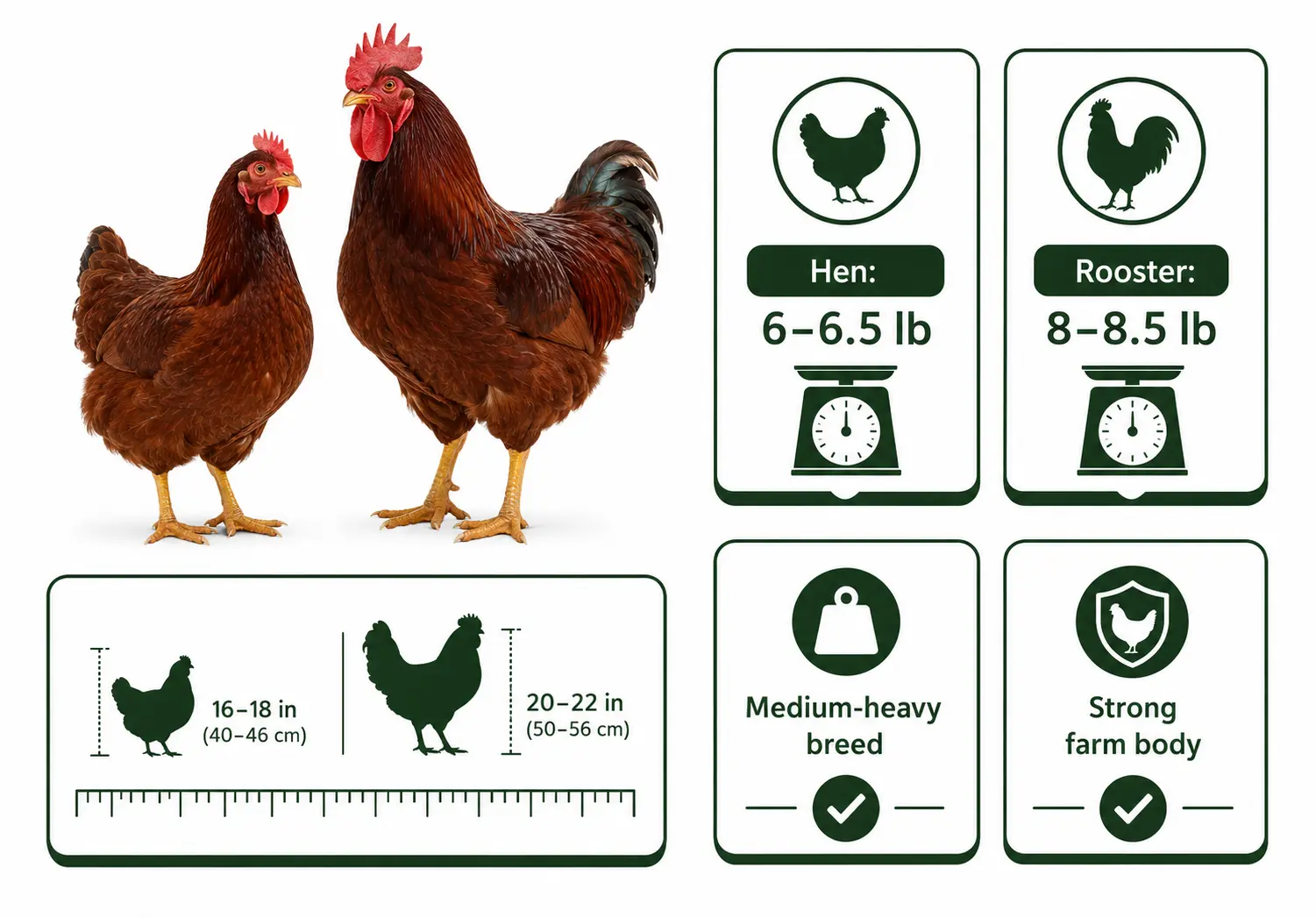
Rhode Island Red size falls into the medium-heavy chicken group. They are not giant chickens like some big meat breeds.
But they’re definitely not tiny. Standard Rhode Island Red weight is roughly:
|
Bird |
Standard Weight |
|
Adult rooster |
8.5 lb |
|
Adult hen |
6.5 lb |
|
Cockerel |
7.5 lb |
|
Pullet |
5.5 lb |
Their size made them useful as dual-purpose birds. A hen is big enough to have a good body but still efficient enough to lay plenty of eggs. The rooster carries more muscle and body mass.
How big do Rhode Island Reds get?
Well, the standard numbers above are a good target. But backyard birds can land a bit above or below them depending on genetics, feeding, age, and strain.
Don’t turn weight into a contest.
A fat chicken is not automatically a healthy chicken. Good muscle, steady movement, bright eyes, healthy feathers, and normal feeding matter more than making the scale climb forever.
Rhode Island Red temperament can be summed up with one word:
Confidence. These chickens are usually active and curious. They like to move around.
Heritage descriptions often call Rhode Island Reds calm, while other records point out that some males can be aggressive. Both can be true. Hens are often fairly manageable, while roosters can be more protective and dominant.
They’re usually not shy little birds hiding in the corner. That is part of why they work well in backyard flocks.
Many are.
Especially hens that get regular calm handling. They may follow people around once they learn that humans are connected to food. Roosters need more respect.
Don’t tease them.
Don’t chase them around for fun.
And don’t let small children corner an adult rooster. A calm flock starts with calm handling.
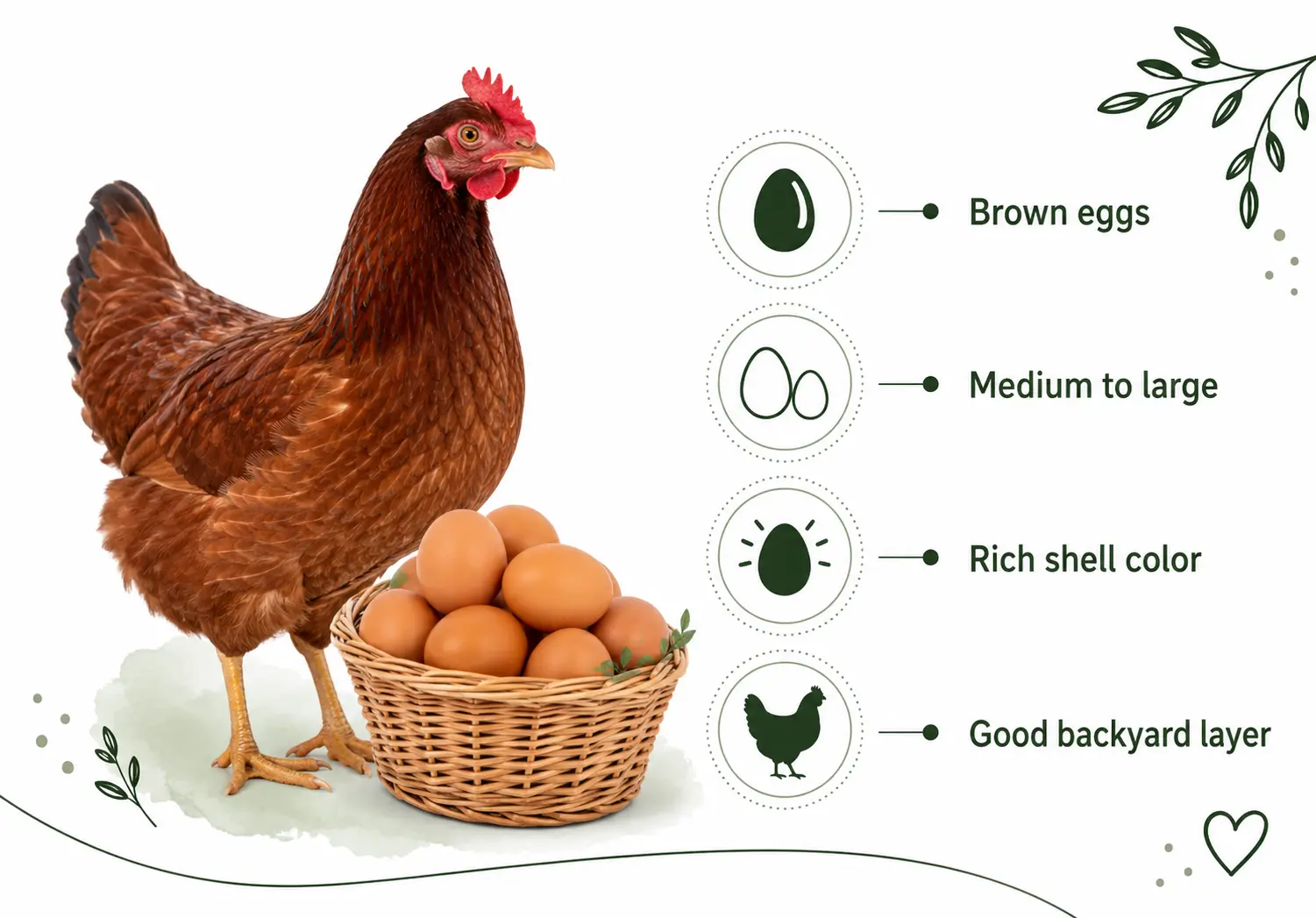
Rhode Island Red egg color is brown.
Simple.
The shade can change a bit from hen to hen. Some eggs are light brown.
Others are medium brown.
Some look richer and slightly darker.
The official breed information lists brown eggshells. A Rhode Island Red hen does not lay red eggs just because the chicken is red.
It would look cool.
But nope. Rhode Island Red chicken eggs are usually medium to large as hens mature. Young pullets may lay smaller eggs when they first start.
That’s normal.
As their reproductive system settles in, egg size often gets more consistent.
This is where the Rhode Island Reds built a serious reputation.
They lay.
A lot.
Depending on the strain, a Rhode Island Red hen may produce around 200 to 300 brown eggs a year. Some older or more heritage-style lines may stay closer to the lower end, while egg-selected strains can push toward 250 or even 300.
That works out to roughly four or five eggs a week for a strong layer during good periods.
Not every week will look the same. Winter can slow things down. Molting can really slow things down. Heat stress can reduce laying. Poor feed can do the same.
Age matters too. A young adult hen normally lays much more than an older hen.
Keep the basics right:
You don’t need magic powder. Good poultry care does most of the heavy lifting.
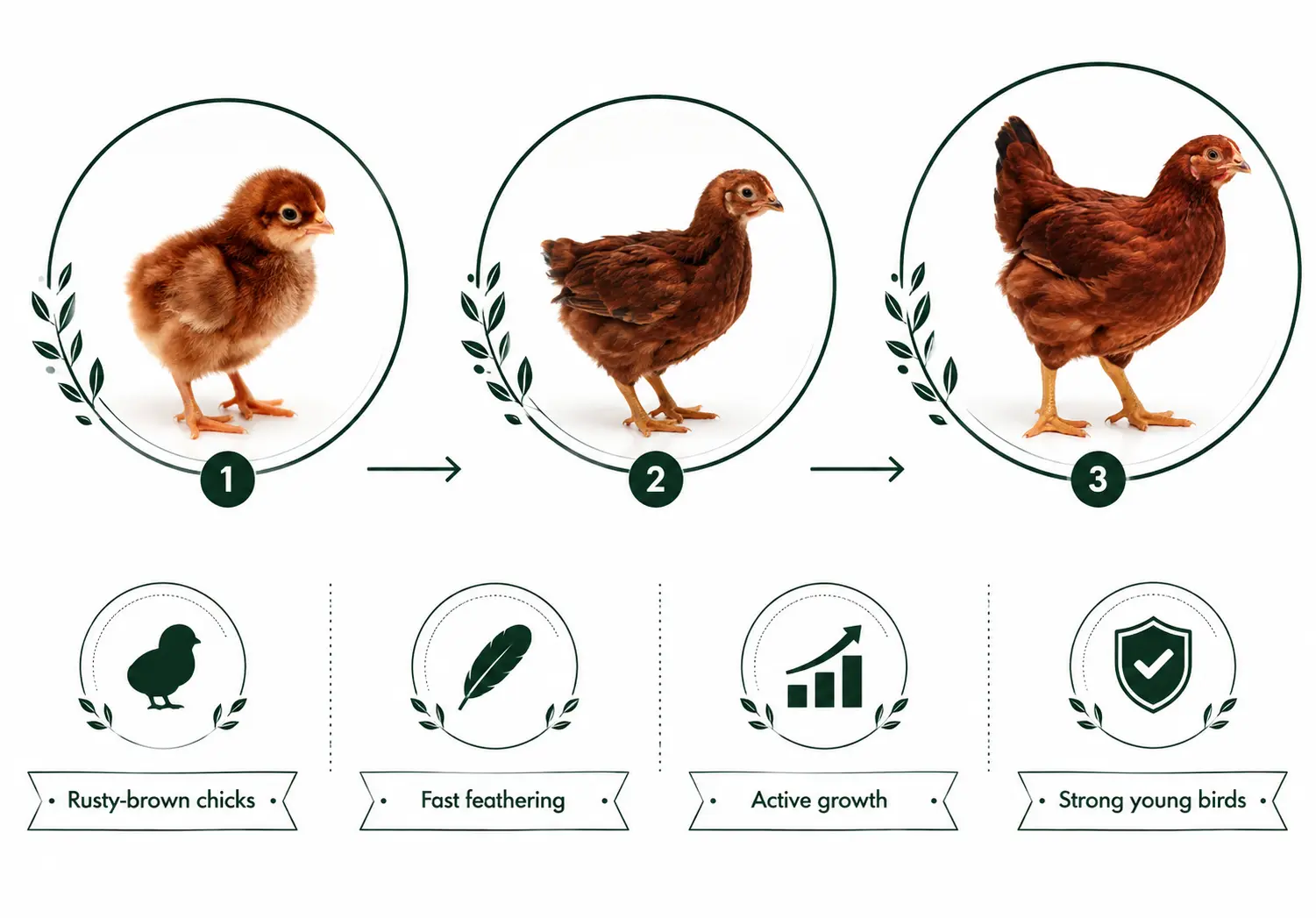
Rhode Island Red chicks start out looking nothing like those deep mahogany adults. They’re usually soft, tiny, and lighter in color. Many Rhode Island Red chicks have reddish-brown, tan, or rusty down.
So, what do Rhode Island Red chicks look like? Think warm brown or rusty fluff. As feathers come in, the color gets deeper.
The tail develops.
The body starts getting longer and heavier. Comb growth also gives little clues about sex, with many young cockerels showing larger, redder combs earlier than pullets. Rhode Island Reds are not super fast commercial meat chickens.
They grow more steadily.
One heritage flock source lists maturity around 12 to 16 weeks, though sexual maturity and full adult body development take longer.
Newly hatched chicks need heat, chick starter, and clean water. Within the first few weeks they feather up fast. By one to two months, they look more like small chickens and less like fuzzy balls.
By several months old, pullets begin moving toward laying age and cockerels start showing much stronger male features.
Rhode Island Red chickens aren’t difficult eaters. A good balanced poultry ration should make up the main part of their diet.
Chicks need a chick starter.
Growing birds need suitable grower feed. Adult laying hens need a layer ration with enough nutrients and calcium.
Water matters just as much. Maybe more than people realize. A chicken can handle missing one snack.
It cannot handle going without clean water in hot weather.
Rhode Island Reds are also good foragers. Historical and modern breed descriptions both mention strong ranging ability.
Let them scratch around a safe yard and they’ll hunt insects, seeds, little plants, and whatever interesting thing they think might be edible.
That doesn’t mean free range food replaces a balanced ration.
It’s extra.
Give them:
And keep the coop clean. Not spotless like a hospital. Just dry, fresh, and not full of wet manure.

Rhode Island Reds have a reputation for being hardy chickens. That was part of the whole point of developing them. They had to survive farm life in New England, where winters aren’t exactly gentle.
A healthy backyard Rhode Island Red may live around 5 to 10 years, though actual lifespan varies with predators, disease, egg production, diet, genetics, and general care.
High-producing hens sometimes have shorter productive lives than light-laying birds because laying puts a lot of demand on the body.
Common chicken health issues can still affect Rhode Island Reds. Watch for mites, lice, worms, respiratory disease, injuries, bumblefoot, and egg-laying problems.
Keep an eye on a chicken that:
One quiet chicken doesn’t always mean disaster. But chickens hide weakness pretty well. If one looks clearly sick, don’t ignore it for a week.
Rhode Island Red breeding sounds simple rooster plus hens, fertile eggs, chicks. But breeding good Rhode Island Reds takes more thought than that. Breeders look at body shape, feather color, health, egg laying, growth, temperament, and overall breed type.
And birds with serious health problems shouldn’t be your first breeding choice. Historical breeders spent decades selecting these traits, which is why Rhode Island Reds became so dependable as farm birds.
Broodiness varies.
Some Rhode Island Red hens will sit on eggs.
Others couldn’t care less. Egg-laying strains have often been selected away from strong broodiness because a broody hen stops laying while she sits.
Yes.
For a lot of people, they’re a really solid backyard chicken.
And most hens are manageable around people. Historical breed descriptions specifically call Rhode Island Reds a strong choice for small flock owners because of their hardiness and laying ability.
They also don’t need some fancy designer coop.
Rhode Island Reds can be assertive around softer breeds. A bold hen may push a timid chicken away from feed or a favorite nesting box. Usually this can be managed with enough space and multiple feeding spots. Roosters deserve another warning too.
Some are calm.
Some definitely are not. If you are keeping one in a family backyard, temperament should matter when choosing a male.
This one causes a fair bit of confusion.
A Production Red and a Rhode Island Red are not always the same thing.
Production Reds are generally commercial or production-focused red chickens bred mainly for strong egg output.
They may have Rhode Island Red ancestry, but they don’t always follow the full Rhode Island Red breed standard.
A true Rhode Island Red has a more defined breed type.
Production birds may be lighter, lay more heavily, mature faster, or show a brighter red color. So if somebody sells “red laying hens,” don’t automatically assume they’re pure Rhode Island Reds.
Ask.

Here are a few fun Rhode Island Red facts worth remembering. Rhode Island Reds were developed in Rhode Island and Massachusetts. They date back to breeding work that started in the 1800s. They became one of America’s best-known dual-purpose chickens.
They lay brown eggs.
They have yellow skin.
Adult roosters are about 8.5 pounds and hens about 6.5 pounds under the standard. They come in both single-comb and rose-comb varieties. Their red feather color may fade with strong sun exposure.
Black tail feathers are normal.
The breed became so closely connected with Rhode Island that it became an official state symbol. And yes, despite the word “Red” being in the name twice, their eggs are still brown.
Rhode Island Reds earned their popularity the old-fashioned way — they proved useful.
A Rhode Island Red hen gives you a strong chance of regular brown eggs. A Rhode Island Red rooster adds size, breeding ability, and that classic farmyard look. The chicks grow into sturdy birds, and the breed generally handles backyard life pretty well when food, water, housing, and health care are kept right.
Their history goes back to practical New England farmers trying to build a chicken that could lay eggs, provide meat, forage outside, and handle rough weather. That same balance is still what makes Rhode Island Reds useful today.