Holland Lop bunnies are tiny rabbits with big floppy ears and sweet round faces. Picture a baby bunny that fits in the palm of your hand. Now picture that same bunny a few months later as a bouncy and confident young rabbit. That fast change is why so many owners search for a growth chart. A good chart shows what is normal at each age so you can relax and enjoy the ride.
Most Holland Lops grow very quickly in their first 7 months. After that they slow down and settle into a compact body that stays small for life. Some bunnies grow faster than others. Some end up a little lighter or heavier than the average. That is okay as long as your bunny eats well and moves around happily.
This guide walks you through each growth stage from birth to adulthood. You will see a simple weight chart by age and learn when your bunny is full grown. You will also learn what adult size looks like and which things change how big your bunny gets. Every tip is easy to follow even if you have never owned a rabbit before.
Quick Peek for Busy Bunny Parents
| Quick Fact | What to Know |
| Adult weight | 2 to 4 pounds |
| Adult height | 4 to 5 inches |
| Adult length | 10 to 12 inches when stretched out |
| Ear length | 4 to 5 inches |
| Weight at 8 weeks | About 11 ounces to 1.5 pounds |
| Full grown age | Most growth is done by 6 to 7 months |
| Life span | 7 to 10 years |
| Biggest growth helpers | Good genes plenty of hay and daily exercise |
Holland Lop Bunny Growth Stages From Birth to Adulthood
A Holland Lop moves through life in clear steps. Each step brings new changes in size and behavior. Many owners compare these steps to human ages because it makes them easier to picture. These stages are a general guide and not a strict rule. Every bunny grows at its own speed.
The first weeks are the most dramatic. Newborn bunnies are called kits. They arrive hairless and blind and they depend on their mother for everything. Within a few weeks they grow fur and open their eyes and start to explore. By the time they reach 12 weeks they look like small versions of the adult rabbit they will become.
Baby Bunny Milestones
- Birth to 3 weeks is like human infancy. Kits grow fast and rely fully on their mother for milk and warmth.
- 3 to 5 weeks is like the toddler stage. Kits start to hop around and nibble hay and show early personality.
- 5 to 12 weeks is like early childhood. Young bunnies learn quickly and get bolder and more curious each week.
Teen and Adult Milestones
- 12 weeks to 4 months is the pre teen stage. Your bunny becomes more independent and behavior may start to shift.
- 4 to 7 months is the teen stage. Energy runs high and the adult shape starts to show.
- 7 months to 2.5 years is early adulthood. Behavior becomes steady and easier to predict.
- 2.5 to 6 years is middle age. Bunnies stay active but may slow down a little.
- 6 to 9 years is the senior stage. Comfort matters more and many bunnies enjoy a calm routine.
- 9 years and up is the elderly stage. Extra care and a quiet space help a lot.
Holland Lop Bunny Weight Chart by Age
Weight is the easiest way to track growth at home. A small kitchen scale works well for a young bunny. Weigh your rabbit once a week at the same time of day and write the number down. A steady climb during the first months is a great sign.
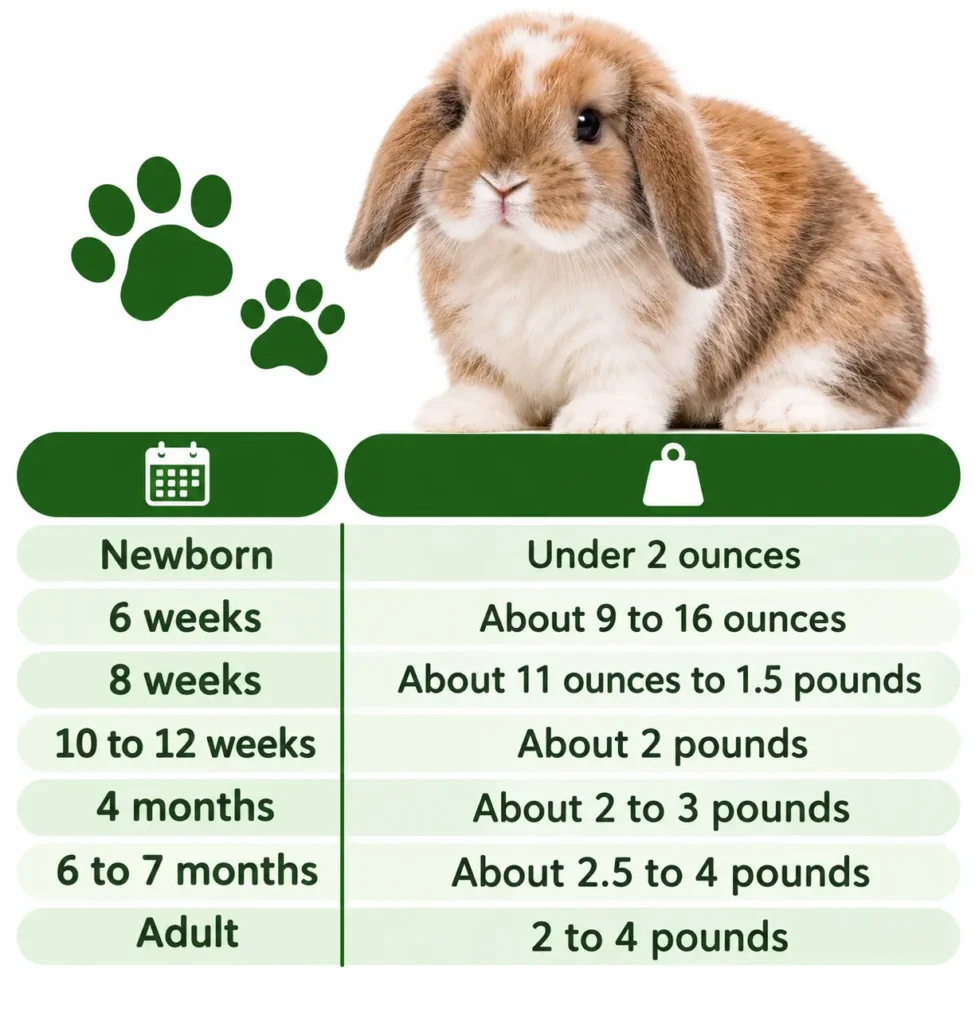
Please treat these numbers as a rough guide. A small bunny from small parents may weigh less at every age and still be perfectly healthy. A bigger bunny may weigh more. What matters most is steady growth and good energy. Your bunny should eat well and pass normal droppings and move around with ease.
Some Holland Lops are called false dwarfs. These bunnies can grow larger than the breed standard and may even pass 4 pounds. A true dwarf usually stays on the smaller side. You cannot always tell which type a baby bunny will be. The best clue is the size of its parents.
If your bunny stops gaining weight or loses weight talk to a rabbit vet. Sudden changes can point to a health problem that needs quick care.
When Is a Holland Lop Bunny Full Grown?
Most Holland Lops reach their mature size between 6 and 7 months of age. By this point your bunny has finished the biggest part of its growth. The legs look strong and the head looks large for the body and the frame looks compact and sturdy. This is the age when many owners say their baby has become a grown rabbit overnight.
Growth does not stop all at once. Your bunny may fill out a little more over the next 6 months. The body may look rounder and more muscular as it matures. This slow filling out is normal and does not mean your bunny is gaining unhealthy weight.
The teen months from 4 to 7 months can be a bit tricky. Hormones start to kick in and energy can be sky high. Some bunnies chew more or act pushy or dig a lot. Many vets suggest spay or neuter surgery around this age so talk with your vet about the best timing for your rabbit. Fixing your bunny can help with behavior and long term health.
A simple way to check if your bunny is done growing is to track its weight. When the number stays about the same for 3 or 4 weeks in a row your rabbit has most likely reached its adult size. A tiny change up or down is normal. A big jump or drop is worth a call to your vet.
Average Adult Holland Lop Size and Weight
A full grown Holland Lop weighs between 2 and 4 pounds. Most land closer to the lower end of that range. The body is short and broad with heavy bones and strong muscles. Adults stand about 4 to 5 inches tall and measure about 10 to 12 inches long when stretched out.
The head is large with a short rounded nose. The ears hang down close to the face and measure about 4 to 5 inches long. These floppy ears are the star feature of the breed. They also need regular cleaning because less air flows inside them.
This breed began in the Netherlands by crossing a larger French Lop with a smaller Netherland Dwarf. That mix gave us a small rabbit with the lop ear look. It is one of the smallest lop breeds in the world.
How Holland Lops Compare to Other Rabbits
- Netherland Dwarf rabbits weigh about 1 to 2.5 pounds.
- Holland Lops weigh about 2 to 4 pounds.
- Mini Lops weigh about 3 to just over 6 pounds.
- English Lops can weigh up to 11 pounds.
- French Lops can reach 11 to 20 pounds.
Despite the name a Mini Lop is bigger than a Holland Lop. That surprises many new owners. If you want a truly small lop rabbit the Holland Lop is a great pick.
Factors That Affect Holland Lop Bunny Growth and Development
Many things shape how your bunny grows. Some you can control and some you cannot. Knowing the difference helps you focus on what matters.
Genes and Family Size
Genetics play the biggest role. A bunny with small parents will most likely stay small. A bunny with larger parents may grow heavier. If you can meet the parents in person you will get a much better idea of the adult size.
Food and Feeding
Diet matters a lot. Hay should make up most of what your bunny eats every day. Offer unlimited hay and a small amount of fresh greens. Add a small portion of pellets. A common guide is about 1/4 cup of pellets per day for every 4 to 5 pounds of rabbit. Too many pellets or sugary treats like fruit can lead to extra weight.
Exercise and Space
Bunnies need to run and hop and stretch. A bunny that sits all day may gain too much weight. Plan for safe playtime outside the enclosure every day. A good home base measures at least 48 by 36 inches across and 12 inches high.
Health and Stress
Sickness and stress can slow growth. Dental trouble can make a bunny stop eating. Tummy problems can cause weight loss. A calm and quiet home helps young bunnies stay relaxed and eat well.

Easy Tips to Keep Your Bunny Growing Strong
- Weigh your bunny once a week and write the number in a notebook.
- Offer unlimited hay every day so teeth and tummy stay healthy.
- Measure pellets instead of guessing.
- Give treats only once in a while and skip sugary ones.
- Let your bunny out to play every day under watch.
- Pick soft flooring and avoid wire bottoms that hurt little feet.
- Brush your bunny at least once or twice a week and more during shedding.
- Ask your vet how to clean the ears the right way.
- Call your vet right away if your bunny stops eating or stops pooping.
Hold your bunny the right way too. Always support the back legs when you pick it up. Strong back legs can kick hard and hurt the spine if your rabbit struggles.
Final Thought
A Holland Lop grows fast in the first 7 months and then settles into a small and sturdy adult of 2 to 4 pounds. Use the growth stages and weight chart as a friendly guide and not as a strict test. Steady weight gain and a good appetite and a happy hop in your bunny tell you more than any single number. Feed lots of hay and give daily playtime and keep a simple weekly weight log. With those habits your Holland Lop has everything it needs to grow into a healthy adult.