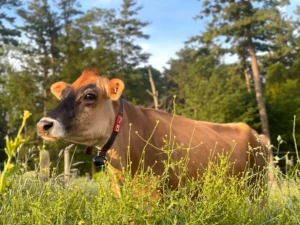
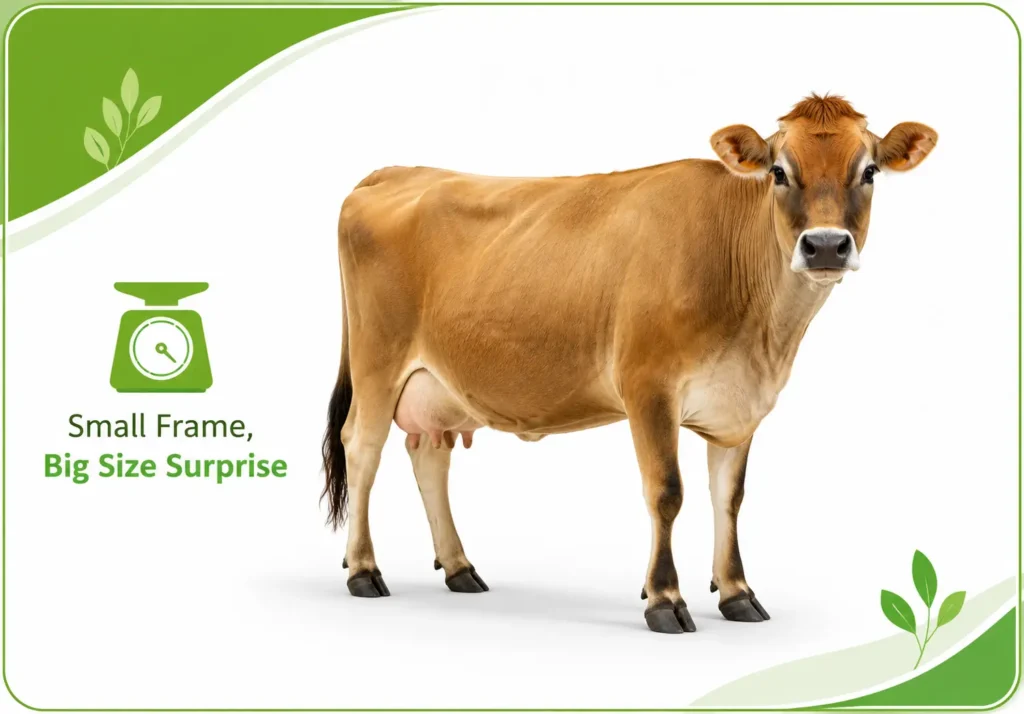
Jersey cows are small compared with most other dairy cattle, and that’s one of the first things people notice about them. Put a Jersey next to a big Holstein and, yep, the size difference is pretty obvious.
But small doesn’t mean weak.
A mature Jersey cow commonly falls somewhere around 350 to 550 kg, or roughly 770 to 1,210 pounds, depending on genetics, age, feeding, pregnancy, and body condition. Some modern herds have mature cows closer to 500 kg or even a little more. Research using dairy cattle growth records has placed mature Jersey body weight around 470 to 520 kg in different systems.
Jersey calves start small too. A newborn may weigh somewhere around 25 to 35 kg, with about 30 to 31 kg being a useful general figure. Females are usually a bit lighter than males.
Then they grow pretty steadily. A well-grown Jersey heifer may be around 117 to 146 kg at six months and roughly 214 to 249 kg at one year, depending on the growth chart and management system being used.
Don’t get stuck chasing one perfect number, though.
Weight makes more sense when you look at age, height, frame, sex, health, and body condition together. A Jersey that weighs less than another cow may still be completely normal for her age and genetics.
Here’s a quick picture before we get into the details.
| Jersey Cattle Stage | Approximate Weight | Approximate Size |
| Newborn calf | 25–35 kg | Small, light frame |
| 6-month heifer | 117–146 kg | Growing calf |
| 12-month heifer | 214–249 kg | Young yearling |
| 15-month heifer | About 256–297 kg | Near breeding stage |
| 24-month heifer | About 358–429 kg | Near first calving |
| Mature Jersey cow | About 350–550 kg | Small dairy cow |
| Mature Jersey bull | Often 500 kg+ | Taller and much heavier |
These aren’t hard limits. They’re useful ranges. Real cattle don’t read charts, after all.
Average Weight of an Adult Jersey Cow
An adult Jersey cow is usually lighter than the larger dairy breeds.
A broad body-weight range of about 350 to 550 kg works well for mature Jersey cows. Some older breed measurements placed mature cows around 350 to 425 kg, while newer dairy populations can average closer to 470, 500, or even above 500 kg depending on the herd.
That sounds like a big range.
It is.
And there’s a reason.
Not every Jersey has the same frame.
Some bloodlines are smaller and finer-boned. Others have been selected for more body size and production, so those cows can be quite a bit heavier.
Age changes things too.
A first-lactation Jersey is still growing. She may have already calved and look like an adult cow, but her body can continue filling out through later lactations.
That’s why comparing a two-year-old cow with a six-year-old mature cow isn’t always fair.
Pregnancy can push the number up as well. So can a full digestive tract. And body condition makes a difference. A fat cow and a lean cow with the same skeletal size can have very different scale weights.
One modern cattle dataset recorded Jersey cows from about 354 kg all the way up to 748 kg, with an average around 558 kg. That doesn’t mean every Jersey should weigh 558 kg. It just shows how much variation can exist in real herds.
What Is a Good Jersey Cow Weight?
A “good” weight is the weight that fits the cow’s frame, age, and production stage.
That matters more than hitting some magic number.
If a mature Jersey weighs 410 kg and has a healthy frame, good appetite, normal movement, and suitable body condition, she may be doing just fine.
Another Jersey could weigh 500 kg and also be normal.
Look at the whole animal.
Not just the scale.
Jersey Bull Weight and Size
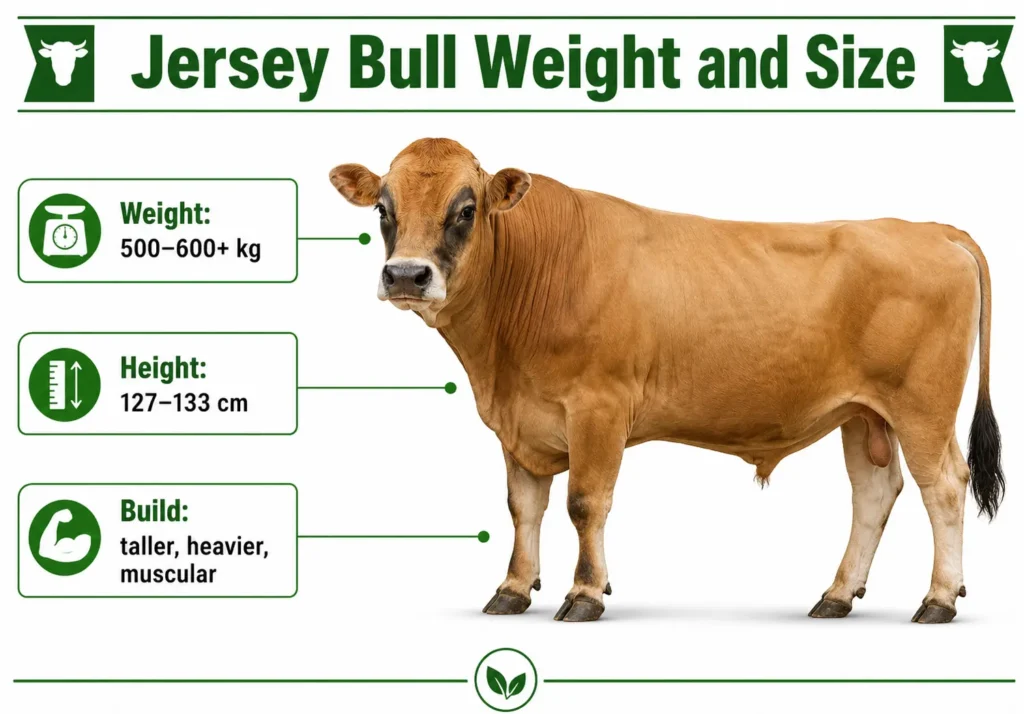
Jersey bulls are a different story.
They grow much heavier and thicker than the cows.
A mature bull usually has a deeper chest, heavier neck, stronger shoulders, and more muscle. Older Jersey measurements placed mature bulls around 500 to 600 kg and about 127 cm tall at the withers.
Modern bulls can be bigger than that.
Adult male size depends heavily on genetics, feeding, age, and whether the bull comes from a larger modern Jersey line.
And bulls don’t finish filling out overnight.
A yearling bull can still look a little narrow and leggy. Give him another couple of years and the chest, neck, and body can thicken up quite a bit.
One study looking at adult Jersey bulls found withers height averaging around 133 cm. Individual animals ranged from about 122 to 148 cm, which again shows just how much real cattle can vary.
Weight goes along with frame.
A wide, mature bull with heavy muscle can easily outweigh a mature cow by a good margin.
Why Jersey Bulls Look So Much Bigger
Part of it comes from male hormones.
Bulls develop heavier muscles around the neck and shoulders. Bone gets thicker too.
You’ll often see:
- Broader chest
- Larger head
- Thick neck
- Heavier shoulders
- More muscle
- Taller body
- Larger overall frame
That difference becomes stronger after puberty. A young bull calf may not look dramatically bigger than a heifer calf at first. Later on? You can usually tell pretty quickly.
Jersey Calf Weight at Birth
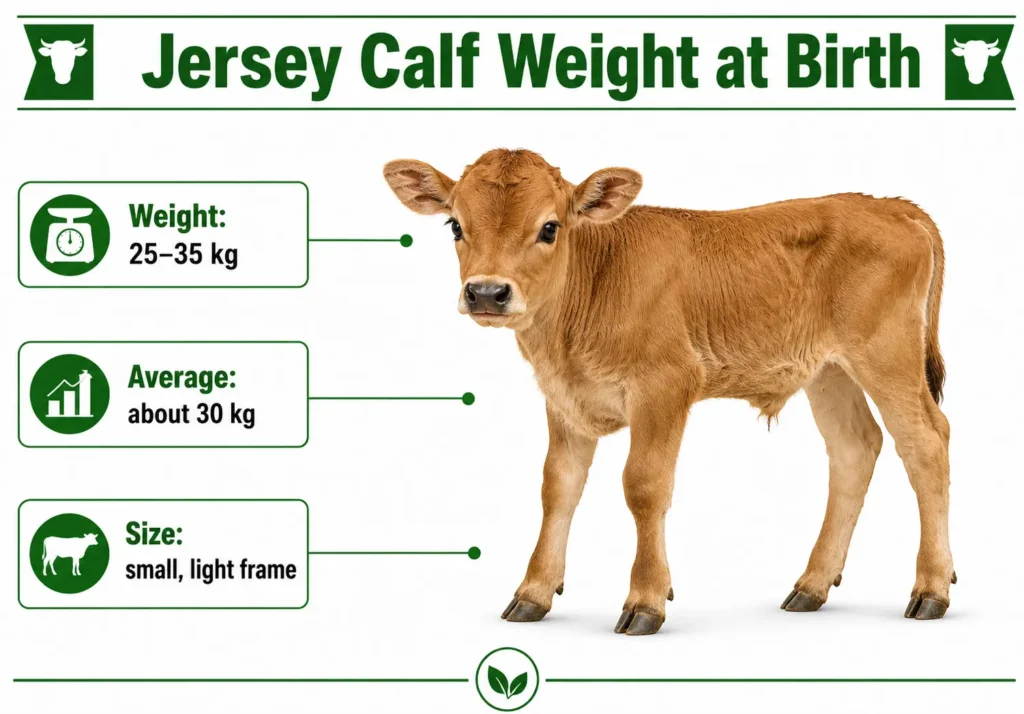
Jersey calves are little guys when they hit the ground. A practical birth-weight range is around 25 to 35 kg. Large-scale feeding standards use roughly 31 kg as a Jersey birth-weight target.
Real herd data shows plenty of variation, though.
One calf study found female calves averaging about 27.6 kg while male calves averaged around 29.5 kg across dairy genetic groups, with Jersey genetics tending to lower calf birth weight compared with Holstein genetics.
Another large dataset of Jersey heifer calves found an average birth weight around 35 kg, with a wide spread between smaller and larger calves.
So don’t panic because one source says 28 kg and another says 31 or 35 kg.
Different herds, genetics, feeding systems, mothers.
That’s cattle for you.
Calf sex matters a little. Males commonly come out heavier.
The age of the mother can matter too. First-calf heifers often give birth to slightly smaller calves than mature cows.
A small birth size has one nice advantage.
It can help with easier calving. Still, tiny calves need watching because they have less body mass to help hold heat. Cold weather can hit a lightweight newborn harder.
Don’t Judge the Calf Only by Birth Weight
A calf can be small and still be strong.
Look for a calf that:
- Gets up
- Looks alert
- Drinks colostrum
- Stays warm
- Has a strong suck
- Moves normally
- Responds to the cow
A bigger calf that won’t drink isn’t automatically better than a smaller calf that’s lively and hungry.
Jersey Cow Weight by Age
Jersey cattle change pretty fast during the first two years.
The newborn stage feels tiny.
Then starter feed kicks in, the rumen develops, and suddenly that calf starts stretching upward and filling out.
Growth charts give us a useful picture.
About two months, a Jersey heifer may be around 55 kg in one set of dairy growth standards. At four months, roughly 100 kg. At six months, around 125 kg and 12 months, around 220 kg.
Another heifer growth chart gives a range instead of a single target.
At six months, Jersey heifers were around 259 to 321 pounds, which comes to about 117 to 146 kg.
At 12 months, the recommended range was roughly 471 to 548 pounds, or around 214 to 249 kg.
Those two sets of numbers line up pretty well.
Here’s a simple age guide:
| Age | Approximate Jersey Heifer Weight |
| Birth | 25–35 kg |
| 2 months | Around 55–70 kg |
| 4 months | Around 85–100 kg |
| 6 months | Around 117–146 kg |
| 8 months | Around 150–185 kg |
| 10 months | Around 177–219 kg |
| 12 months | Around 214–249 kg |
| 15 months | Around 256–297 kg |
| 18 months | Around 290–342 kg |
| 24 months | Around 358–429 kg |
Actual growth doesn’t follow a ruler-straight line. A calf might grow fast through spring, slow during bad weather, then catch up later. Sickness can knock weight gain down. Weaning can cause a little wobble too. The key is the long-term direction.
Up.
Steady.
Healthy.
Jersey Heifer Weight at 6 and 12 Months
Six months and 12 months are two handy checkpoints.
At six months, a Jersey heifer commonly lands around 117 to 146 kg in established growth charts. Another set of dairy recommendations gives about 125 kg as a median target.
That’s a useful stage because milk is long gone for most heifers. Now growth depends much more on forage, grain or concentrate where used, minerals, water, and overall health.
If a six-month-old calf is way behind, take a look at the basics. Maybe the pasture isn’t as good as it looks.
I think so hay is mostly stem.
Maybe parasites are chewing away at performance.
Maybe she had scours or respiratory disease earlier and never caught back up.
At 12 months, many Jersey heifers fall roughly around 214 to 249 kg, while one traditional median target places them near 220 kg.
That’s a pretty big jump from birth.
A 30 kg calf reaching around 220 kg in one year has added roughly 190 kg. Not bad for a calf that looked tiny on day one.
Height Matters Too
Don’t just push feed until the scale looks good.
A fat 12-month-old heifer isn’t the same thing as a well-grown heifer.
You want a frame.
Height.
Bone.
Muscle.
And enough body condition without turning the animal overly fat. Growth charts are useful because they pair body weight with height instead of pretending weight tells the whole story.
Male vs Female Jersey Cattle Weight
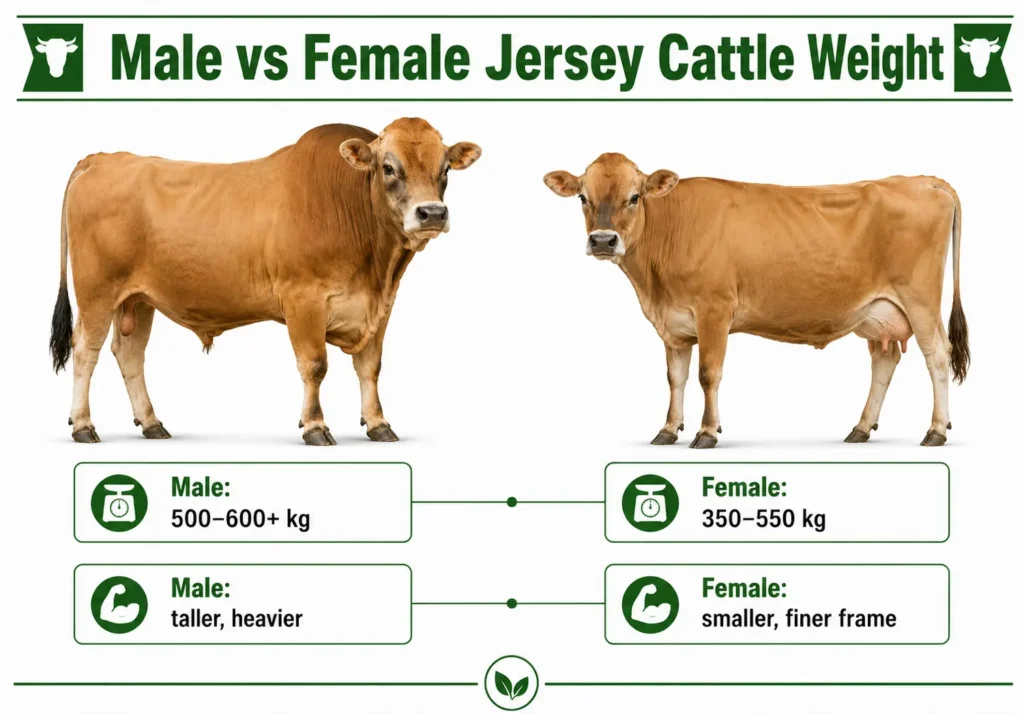
Male Jerseys grow heavier than females.
At birth, the difference is usually pretty small.
A few pounds.
A couple of kilograms.
But it grows with age.
Male calves often start a little heavier than female calves, and research has measured this birth-weight difference across Jersey and related dairy cattle groups.
Then puberty kicks in.
Bulls start developing heavier muscles, stronger bone, and a bigger front end.
Adult cows stay finer.
They’re built for dairy production rather than carrying huge blocks of muscle. A mature Jersey cow may weigh around 350 to 550 kg. A mature bull can move into the 500 to 600 kg range or beyond depending on the animal.
That sex difference is totally normal. Steers sit somewhere in another category because castration changes how the animal develops. They don’t build the same heavy neck and shoulder muscles as intact bulls.
Still, a well-grown Jersey steer can become a solid animal.
Jersey Cow Height and Body Size
Jerseys are short compared with the big dairy breeds.
And that compact size is part of their look.
Historical breed measurements placed mature Jersey cows around 46 inches, or about 117 cm, at the withers. Mature bulls were around 50 inches, or about 127 cm.
Modern research has recorded adult Jersey cows averaging roughly 126 cm at the withers, with individual cows ranging from around 117 to 135 cm. So think roughly 117 to 130 cm for many adult females.
Some will be shorter.
Some are taller.
Jersey heifers grow upward fast during their first year.
At six months, the recommended withers height may fall around 36 to 39 inches or 12 months, around 42 to 44 inches.
At 24 months, around 48 to 50 inches.
Height helps explain why two animals with similar weight may not actually be in the same condition.
A taller heifer can weigh more simply because she has a bigger frame.
That’s why looking at weight without height can throw you off the scent.
What Gives a Jersey Its Small Look?
A few features:
Shorter overall frame.
Fine bone.
Narrower body than large dairy breeds.
Smaller head.
Less body mass.
But a mature Jersey can still have a deep barrel and strong dairy frame.
Small doesn’t mean miniature.
These are still full-sized cattle.
Factors That Affect Jersey Cow Weight
Weight comes from more than breed.
A lot more.
Genetics sets the rough frame, but management decides how much of that potential the animal actually reaches.
Genetics
Some Jersey families naturally produce larger cows.
Others stay smaller.
Growth rate, mature size, height, and body weight all have a genetic side. That’s why one herd may average noticeably heavier than another even if both are pure Jersey.
Feed Quality
This one is huge.
Growing cattle need enough energy and protein.
Poor-quality forage can leave young heifers underweight or undersized, even when there seems to be plenty of feed in front of them. Growth guidance also points to poor forage, unbalanced grain feeding, crowding, and housing problems as causes of weak heifer growth.
A belly full of low-quality hay isn’t the same as a balanced diet.
Health
Sick cattle don’t grow well.
Pretty straightforward.
A calf fighting diarrhea, pneumonia, worms, or another illness uses energy just trying to recover. That energy isn’t going into the frame and muscle. Sometimes the sickness only lasts a week, but the growth setback hangs around much longer.
Water
Easy to overlook.
Big mistake.
Cattle need clean water for digestion, feed intake, milk production, and normal body function. If water access is poor, feed intake can fall too. And once eating drops, weight can follow.
Parasites
Worms can be sneaky.
A Jersey heifer may still walk around, eat, and look mostly normal while growing slower than she should. Repeated poor gain on good feed is one reason parasites deserve a look.
Pregnancy
A pregnant Jersey cow gets heavier as pregnancy moves along.
Part of that extra scale weight comes from the calf, placenta, fluids, and changes in the reproductive tract. That’s why comparing late-pregnancy weight with weight after calving can be misleading.
Body Condition
Body condition and body size are not the same.
A big-framed thin cow may weigh less than expected. A small-framed fat cow may weigh more. Neither number tells you the whole story on its own.
Research comparing cattle breeds found that body condition changes weight, although true breed size differences remain even after accounting for condition.
Age
Young Jersey cows are still developing. A first-calf heifer may not have reached full mature weight yet. Later, mature cows tend to carry more body. Very old animals can sometimes lose condition if teeth, health, or feed competition becomes a problem.
Jersey Cow Weight Compared With Other Dairy Breeds
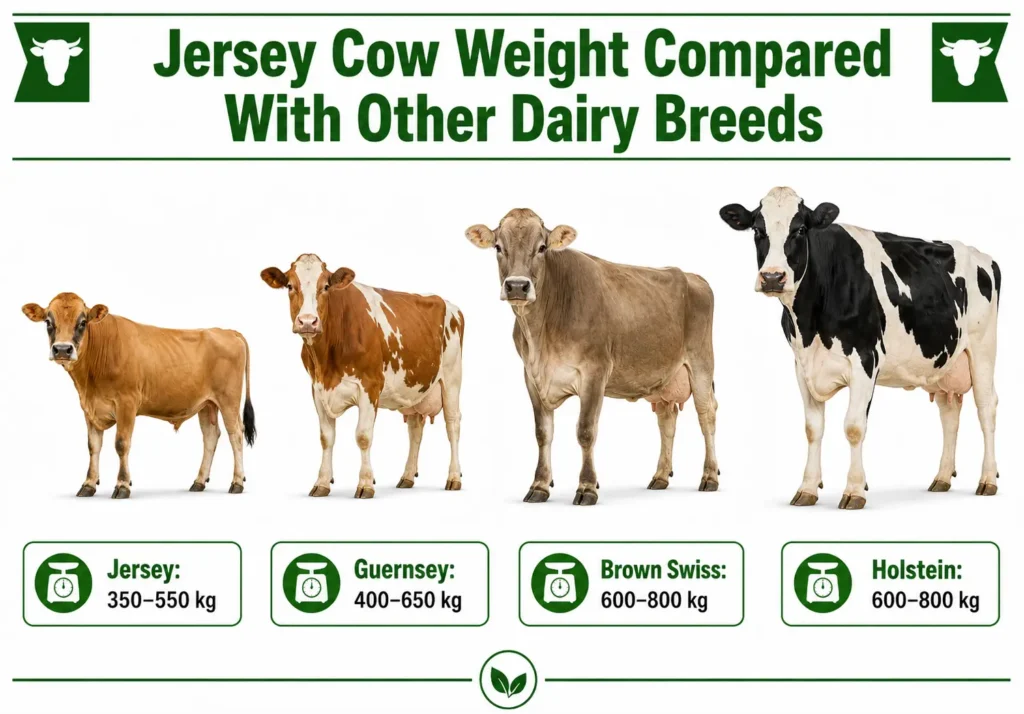
This is where Jersey cattle really stand out.
They’re one of the smallest major dairy breeds.
A broad dairy-breed comparison puts Jersey body weight around 350 to 550 kg.
Guernsey cattle may run about 400 to 650 kg.
Ayrshires around 550 to 700 kg.
Brown Swiss around 600 to 800 kg.
Holsteins around 600 to 800 kg.
So yes, Jerseys are clearly on the light side.
Research following dairy heifers across several breeds found the same pattern: Holsteins were the heaviest, followed by Brown Swiss and Ayrshire, with Jersey heifers staying the lightest through growth.
Another mature-cow dataset found Jersey cows averaging about 558 kg while Holsteins averaged around 690 kg.
That difference affects more than appearance. Smaller cattle generally need less total feed for body maintenance than giant cows. They’re easier on some facilities.
They take up less space.
But don’t take that too far a mature Jersey is still a several-hundred-kilogram animal. She’s not a backyard pet-sized cow.
Simple Breed Weight Comparison
| Dairy Breed | Approximate Mature Body Weight |
| Jersey | 350–550 kg |
| Guernsey | 400–650 kg |
| Ayrshire | 550–700 kg |
| Brown Swiss | 600–800 kg |
| Holstein | 600–800 kg |
These ranges overlap.
A huge Jersey may outweigh a small Guernsey. A lightweight Holstein may sit below a big Brown Swiss. Breed gives you the rough picture, not an exact guarantee.
How to Tell if a Jersey Cow Is Too Light
Sometimes you don’t have a scale.
Fair enough.
You can still learn quite a bit from the animal. Look over the ribs, spine, hooks, pins, shoulders, and tail-head area. A little bone showing can be normal in a dairy cow. They’re not supposed to look like heavily muscled beef cattle.
But sharp bones everywhere, poor muscle, weak appetite, and steady weight loss deserve attention. Run your hand over the body too.
Eyes can lie.
Hair, dirt, pregnancy, and a full rumen can all change how a cow looks from a distance.
If she looks thin and keeps losing condition even while feed seems good, check health rather than just tossing more grain at the problem.
How to Measure Jersey Cow Weight Without a Scale
A livestock scale gives the best number.
No surprise there.
But it’s not always available.
A heart-girth tape can give a useful estimate.
The tape wraps around the chest just behind the front legs and converts that measurement into estimated body weight.
It isn’t perfect.
Still, it can be handy for following growth.
The real trick is using the same method every time.
Same tape.
Same body position.
Similar feeding time if possible.
That makes the trend much more useful.
Height can be checked at the withers — the high point over the shoulders. Put the cow on level ground and measure straight up rather than following the body angle. Traditional Jersey measurements and modern heifer growth systems both use withers height as a practical size measure.
Why Tracking Jersey Weight Actually Matters
You don’t need to weigh cattle because you’re obsessed with numbers. The number is useful because it can catch problems. A six-month heifer falling far behind her growth group may need better feed.
A yearling getting too fat may need the ration adjusted. A mature cow dropping weight quickly after calving might need a closer health and nutrition check.
Breeding decisions are tied to growth too.
Dairy-heifer guidance often uses body weight as a better breeding marker than age alone. Jersey heifers may reach a suitable breeding weight around 55% of mature body weight. Depending on the mature-weight standard being used, that can land somewhere around 259 to 295 kg.
That’s why “she’s 13 months old” isn’t enough information by itself.
Is she grown enough?
That’s the better question.
Final Thought
Jersey cows are small dairy cattle, but their body weight changes a lot from birth to full maturity.
A newborn Jersey calf may start around 25 to 35 kg. By six months, a well-grown heifer can be somewhere around 117 to 146 kg. At one year, many fall roughly around 214 to 249 kg. Then growth keeps going through breeding, first calving, and later maturity.
A mature Jersey cow commonly sits somewhere in the broad 350 to 550 kg range, though modern herd averages can go higher. Bulls are bigger again, with older mature-bull figures around 500 to 600 kg and some individuals growing beyond that.
Don’t get hung up on one perfect Jersey cow weight.
Watch the trend.
Check height.
Look at body condition. Think about age, pregnancy, health, genetics, and feeding. One scale number is useful, sure. But the whole cow tells you much more.