A Mini Highland cow size and weight chart can help you plan feed and housing. It can also stop you from buying a young calf that may grow much larger than expected.
There is one important fact to understand first.
“Mini Highland” is not an official Highland breed recognised by major Highland cattle societies. The Canadian Highland Cattle Society says official Highland breed societies do not recognise a separate miniature Highland breed or version. Sellers may use words such as mini or micro or midsize in different ways.
Some mini cattle come from smaller Highland bloodlines. Others are Highland crosses. A few carry short-leg genes from another breed. This means two animals sold under the same label can finish at very different sizes.
Informal mini cattle guides often place mature animals between 36 and 48 inches at the rear hip. Their adult weight may fall between 400 and 800 pounds. These figures work as planning estimates. They are not an official Highland breed standard.
The safest way to predict adult size is to measure both parents. Ask for their mature height and weight. Do not judge a calf from a cute photo.
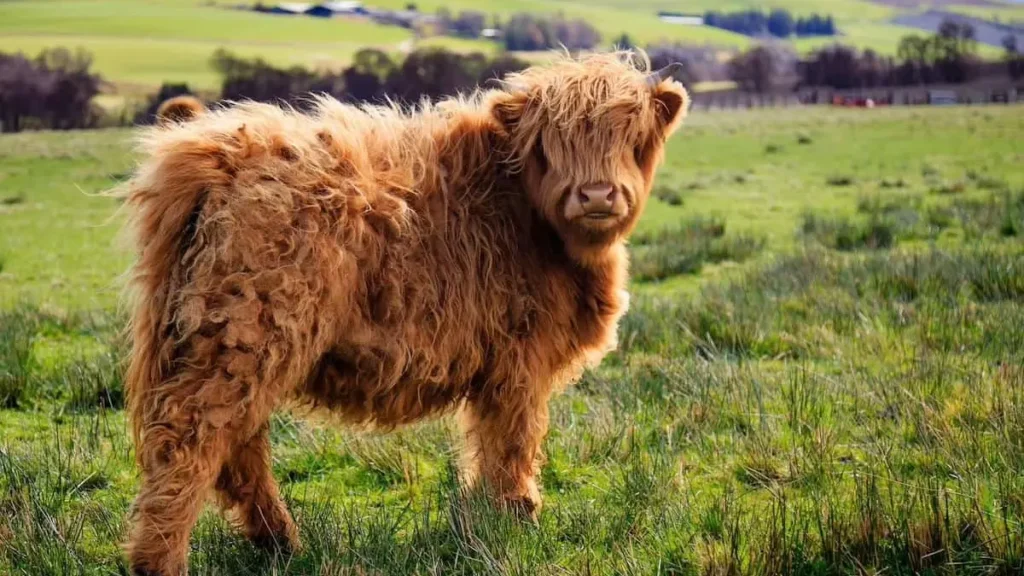
Mini Highland Cow Height and Weight by Age
Mini Highland cattle grow for several years. A small six-month-old calf is not close to its finished body size.
Height develops before full body weight. Many minis get close to their final hip height by three years old. Their chest and muscles may continue filling out until four or five years old.
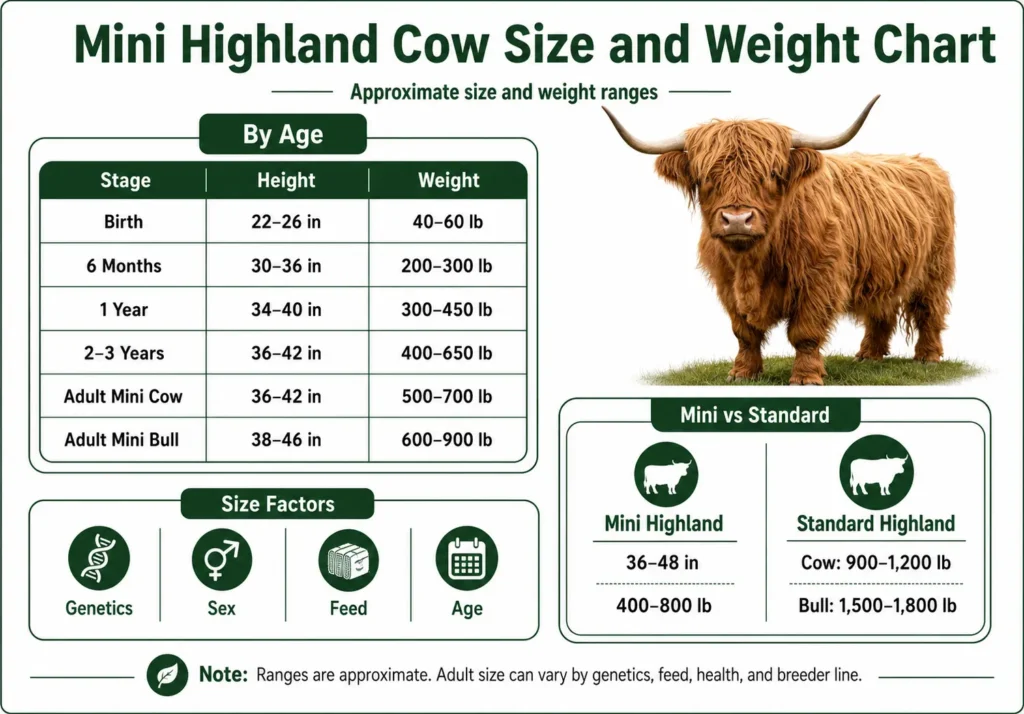
Approximate Mini Highland Growth Chart
The chart below uses informal breeder ranges. It should help with planning rather than act as a strict breed rule.
| Age | Approximate height or weight | What to expect |
| Birth | Around 40 to 60 pounds | Some calves stand close to 24 inches at the hip |
| 6 months | Around 200 to 300 pounds | Many calves reach weaning age |
| 1 year | No reliable universal range | The yearling still has a lot of growing left |
| 2 years | Often close to mature height | The body remains narrow and continues filling out |
| 3 years | Adult height becomes clearer | Mini size classes often use height at this age |
| 4 to 5 years | Full body weight develops | Chest depth and muscle become more mature |
| Mature mini or midsize animal | About 400 to 800 pounds | Height may range from 36 to 48 inches at the rear hip |
These figures can change widely. Sex and parent size matter. A crossbred animal may also grow outside this range. Informal mini Highland records commonly use about 40 to 60 pounds at birth and 200 to 300 pounds near six months.
Why an Age Chart Cannot Give One Exact Answer
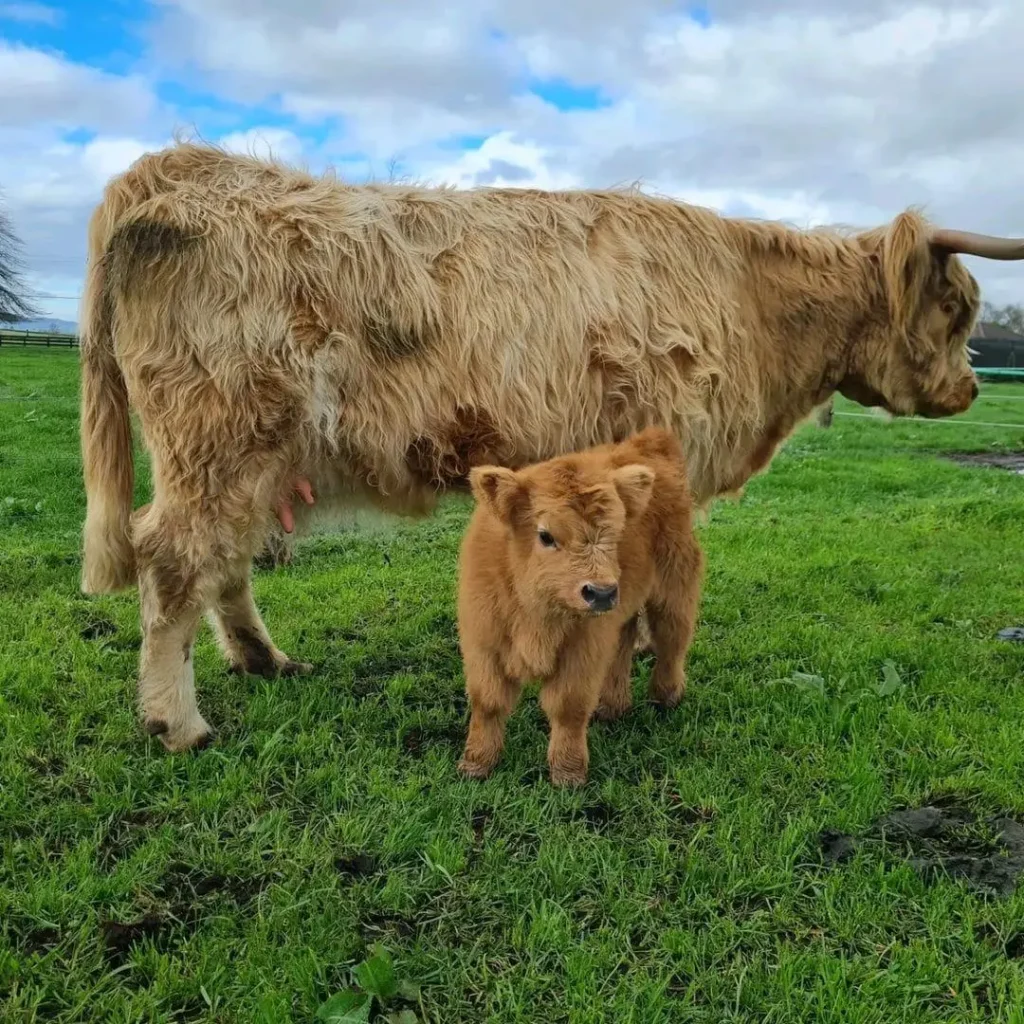
A standardised breed chart uses data from many animals with known pedigrees. Mini Highlands do not have one official global standard.
One breeder may call a 47-inch cow a mini. Another may call her midsize. A third breeder may only use the mini label below 42 inches.
Weight creates even more variation. A short cow with a deep body can weigh more than a taller cow with a narrow frame.
Use the chart to notice growth changes. Do not use it as proof of future size.
Newborn Mini Highland Calf Size and Birth Weight
A newborn mini Highland calf may weigh around 40 to 60 pounds. Some will fall outside that range.
For comparison a standard Highland calf commonly weighs about 60 to 70 pounds. Highland calves have a reputation for moderate birth weight and easier calving.
A low number does not always mean the calf is a true mini. Premature calves and weak calves may also weigh less. Birth weight should match the calf’s health and family genetics.
What Controls Calf Birth Size?
The mother affects calf size through her own body frame and pelvic room. The father supplies half of the calf’s genes. A large bull may produce heavier calves even when the mother is small.
Bull calves often weigh more than heifer calves. A mature cow may also produce a larger calf than a first-calf heifer.
Feed during pregnancy matters as well. The cow needs enough protein and energy to support normal fetal growth. Severe underfeeding can produce a weak calf. Heavy overfeeding may leave the cow too fat and make birth harder.
Highland breed guidance says the final part of pregnancy plays a major role in calf growth. The cow should enter calving in a healthy condition rather than becoming very thin or very fat.
Birth Weight Is Only the Starting Point
A small calf can grow into a fairly large adult. A heavier calf from small-framed parents may stay moderate as it matures.
Adult height depends more on long-term genetics than one birth measurement.
Record the calf’s birth weight when possible. Measure its hip height too. Repeat both measurements at weaning and at one year old.
These records become useful after several calves. They show which parent combinations produce the size you want.
Adult Female Mini Highland Cow Size
An adult female usually stays lighter than an adult bull of the same height class.
Informal mini cattle systems often describe a true mini female as standing between 36 and 42 inches at the rear hip. Animals between 42 and 48 inches are often sold as midsize minis.
Weight may range from about 400 to 800 pounds across the wider mini and midsize group. Many adult females stay in the lower or middle part of that range. Large-framed or crossbred females may weigh more.
Height Matters More Than Fluffy Appearance
A Highland cow’s coat makes her look bigger. Thick winter hair adds width around the shoulders and belly.
Measure the animal at the rear hip on level ground. Do not include the hair in the measurement. Press the measuring bar down gently until it reaches the body.
The cow should stand square. A cow standing uphill can give a false reading. A raised head can also change her body position.
Adult height should not be confirmed from a one-year-old animal. The animal may still gain several inches.
Pregnancy Changes Weight
A pregnant cow becomes heavier during late gestation. The calf and pregnancy fluids add weight. Feed and water inside the digestive tract also affect the scale. A cow may therefore weigh more before calving than she does a few weeks later. This does not mean her frame became smaller.
Compare weights at similar life stages. For example, weigh her before breeding each year. This gives a cleaner picture of body growth and condition. A healthy mini cow should have a balanced frame. She needs enough chest depth and pelvic room to eat well and deliver a calf safely.
The smallest cow is not always the best breeding cow.
Adult Mini Highland Bull Height and Weight
Mini Highland bulls usually grow heavier through the neck and shoulders. They may stand slightly taller than females from the same family.
Informal estimates often place mature mini and midsize bulls between about 600 and 1000 pounds. Smaller bulls may remain below this range. Large midsize bulls and crosses may move above it.
Their hip height may fall between 36 and 48 inches depending on the size label used by the breeder. These are market estimates rather than official Highland measurements.
Bulls Keep Filling Out
A two-year-old bull may appear fully grown. His body can still add muscle and chest depth for several more years.
This slow development is normal for Highland cattle. Do not assume a narrow young bull will stay light forever. A bull’s mature size should match the females he will breed. A very heavy bull may create handling problems for small cows. His calf genetics may also increase birth weight.
Look at calving records from his family. Parent height alone does not show calving ease.
A Mini Bull Is Still Powerful
The word mini can give owners a false feeling of safety.
A 700-pound bull can crush a person against a gate. Horns add another risk. Small cattle still need strong fencing and proper handling equipment.
Do not keep an intact bull only because he looked calm as a calf. Bull behaviour can change after sexual maturity.
A steer may suit a pet home better. A steer is a castrated male. He does not carry the same breeding behaviour as an intact bull. He still needs cattle-safe fencing and a bovine companion.
Mini Highland Cow Growth Rate and Stages
Mini Highlands do not grow at the same speed every month. Growth becomes fast during some stages and slower during others.
A newborn uses milk for early growth. After weaning the rumen and forage diet become more important. Yearlings add height and length. Mature cattle add body depth and muscle.
Birth to Six Months
The calf should stand and nurse soon after birth. Colostrum gives energy and early immune protection.
Milk from the mother drives much of the first growth period. The calf begins tasting grass and hay while it is still nursing. Health trouble can slow growth quickly at this age. Diarrhoea and pneumonia may leave a calf far behind its group. A fluffy coat can hide weight loss. Run a hand over the ribs and spine during safe handling.
Six Months to One Year
Many calves leave their mothers near six months. Weaning creates stress so the calf needs good forage and clean water.
Do not judge adult size at this stage. A calf may look short because its legs grew early while its body still looks small. Another may look large because it carries too much fat.
Highland breed guidance says calves can gain around 0.8 to 1 kilogram each day under suitable conditions and may reach about half of their mother’s weight in one year. Mini and crossbred cattle may not follow that exact pace.
One to Three Years
The animal continues adding height. Females may begin cycling before their bodies have enough size for safe breeding. Breeding only by age can create problems. The heifer should have enough body weight and pelvic development first.
By three years the final height becomes easier to judge. The animal may still look lean through the chest.
Three to Five Years
The skeleton grows more slowly. Muscle and body depth continue developing.
A mature cow often looks wider and heavier than she did at three years even when her hip height stays the same.
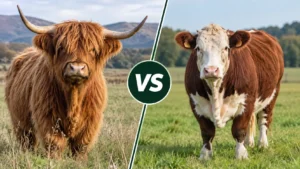
Mini Highland Cow vs Standard Highland Cow Size
Standard Highland cattle have established breed records. Mini Highlands do not have one official world standard.
The American Highland Cattle Association reports that mature Highland cows usually weigh 900 to 1200 pounds. Mature bulls often weigh 1500 to 1800 pounds.
Mini and midsize cattle are commonly advertised at 400 to 800 pounds. This means a small Highland-type cow may weigh about half as much as a full-sized bull.
Simple Size Comparison
A standard mature cow can weigh 300 to 700 pounds more than a mini female. A standard bull may weigh almost twice as much as a midsize mini bull.
Official Highland Cattle Society records also show how much standard bulls continue growing. Bulls offered at its February 2025 sale averaged 597 kilograms at two years old and 743 kilograms at three years old. That equals about 1316 and 1638 pounds.
Those numbers come from selected sale bulls. They do not represent mini cattle.
Height can overlap between a small traditional Highland and an animal sold as midsize. This is why pedigree and parent records matter more than a sales label.
Does Smaller Mean Easier?
A lighter animal normally eats less than a much heavier animal. It also places less total weight on a trailer and handling system.
Smaller does not mean easy like a dog.
Mini cattle still need pasture or hay. They need minerals and fresh water. They also need hoof care and veterinary treatment. Their wide horns can create problems in narrow feeders. A small body does not make the horn span small.
Before buying one check these details:
- Mature height and weight of both parents
- The animal’s real age and current measurements
- Full Highland or crossbred status
- Registration and parent verification records
- Health and genetic test results
- The meaning of mini used by that breeder
- Expected horn growth and handling needs
Factors That Affect Mini Highland Cow Weight
Two mini Highland cows of the same age may not weigh the same. Several factors shape their final size.
Genetics and Parent Size
Genes create the basic frame. Small mature parents give a better size clue than a tiny calf photo.
Ask for measured parent heights. Words such as small or compact do not give a useful number.
Crossbreeding changes size too. Dexter or other miniature cattle genetics may reduce height. A larger beef breed in the background may add weight.
Sex and Reproductive Stage
Bulls develop more muscle than cows. Steers often fall between bulls and cows in body shape.
Pregnancy raises a female’s weight. Lactation may lower her body condition when she cannot eat enough to meet milk needs.
Compare similar animals. Do not compare a pregnant mature cow with a young empty heifer.
Feed and Pasture
Good forage helps the animal reach its natural frame. Poor feed may hold back growth but does not create a healthy mini.
Grain can add weight quickly. Too much grain may produce fat rather than strong growth. Sudden grain changes can also upset the rumen.
Health and Parasites
Parasites reduce nutrient use. Dental problems make hay hard to chew. Lameness may stop the animal from walking to feed.
Long Highland hair can hide a thin body. Use a hands-on body condition check.
Dwarfism Genes
Some cattle sold as micro or mini carry a chondrodysplasia gene. Buyers should understand this before breeding.
UC Davis explains that carriers may look short while carrying one copy of a bulldog dwarfism variant. Breeding two carriers creates a 25 percent chance of producing an affected pregnancy. Affected fetuses have severe body changes and are usually lost around seven months. The laboratory includes Miniature Scottish Highland cattle among the types suitable for testing.
Small size produced through balanced selective breeding is not the same as a harmful genetic disorder.
Measurement Method
One seller may measure at the shoulder. Another may measure at the rear hip. These readings are not equal.
Weight may also come from a scale or a tape estimate. Ask how the number was collected.
Use the following method to track growth:
- Place the animal on firm and level ground.
- Let it stand with all four feet in a natural position.
- Measure the highest point of the rear hip.
- Press through the coat without pushing down on the body.
- Record the date and the animal’s exact age.
- Use a livestock scale for the best weight.
- Repeat the measurements every three to six months.
- Compare the animal with its own past records rather than random online photos.
Final Thought
A Mini Highland cow size and weight chart gives you a useful starting point. It cannot promise the final size of every animal.
Informal mini Highlands often stand between 36 and 48 inches at the rear hip. Their mature weight may range from 400 to 800 pounds. Bulls usually weigh more than cows. Some crossbred or midsize animals grow beyond those figures.
A newborn mini calf may weigh around 40 to 60 pounds. By six months it may reach roughly 200 to 300 pounds. Height becomes clearer near three years. Full body weight may not develop until four or five years.
Remember that major Highland breed societies do not recognise a separate miniature Highland breed. The word mini can mean something different on every farm.
Do not buy by looks alone. Ask for the parents’ mature measurements. Check the pedigree and genetic history. Learn whether the animal carries a dwarfism gene.
A healthy balanced cow matters more than the smallest number on a chart. Choose strong legs and a deep body. Look for normal movement and enough pelvic room.
Good records give the clearest answer. Measure the animal as it grows. Over time those numbers will tell you much more than a fluffy calf photo ever can.