Choosing between a Jersey cow and a Brown Swiss cow can get a little confusing at first. These are popular dairy cattle. Both can produce rich useful milk. Both can live in different climates when farmers manage them properly. Still, they’re not the same cow with a different coat color.
Jerseys are smaller, lighter, and famous for milk that contains a lot of butterfat and protein. Brown Swiss cows are much bigger, have strong bodies, and normally produce more total milk. Their milk also has pretty good fat and protein levels, which makes them useful when milk solids matter.
So, which one is better?
Well, that depends on what you actually need. A small pasture farm may look at these breeds differently from a larger dairy. Feed prices matter too. Hot weather matters. Available land matters. Even the type of milk you want to sell can change the answer.
And don’t get hung up on one milk-yield number you see online. Milk production changes with genetics, age, feed, climate, lactation stage, and management. Recorded Jersey herds in different countries can average roughly 6,000 to nearly 8,000 kg of milk in a lactation, while well-managed Brown Swiss populations commonly fall around 7,000 to 10,000 kg or more. Individual cows can go higher or lower.
Here’s the quick picture.
| Feature | Jersey Cow | Brown Swiss Cow |
| Mature cow weight | Around 880–1,100 lb | Around 1,300–1,400 lb, sometimes more |
| Body size | Small | Medium-large to large |
| Milk volume | Moderate | Usually higher |
| Butterfat | Very high | High |
| Milk protein | Very high | High |
| Feed needed per cow | Lower in general | Higher because of larger body size |
| Temperament | Alert, active, usually manageable | Calm and usually very docile |
| Heat tolerance | Very good | Good adaptability to heat and cold |
| Main strength | Rich milk from a smaller cow | Milk volume, strength, and durability |
Jersey Cow vs Brown Swiss: Size and Weight
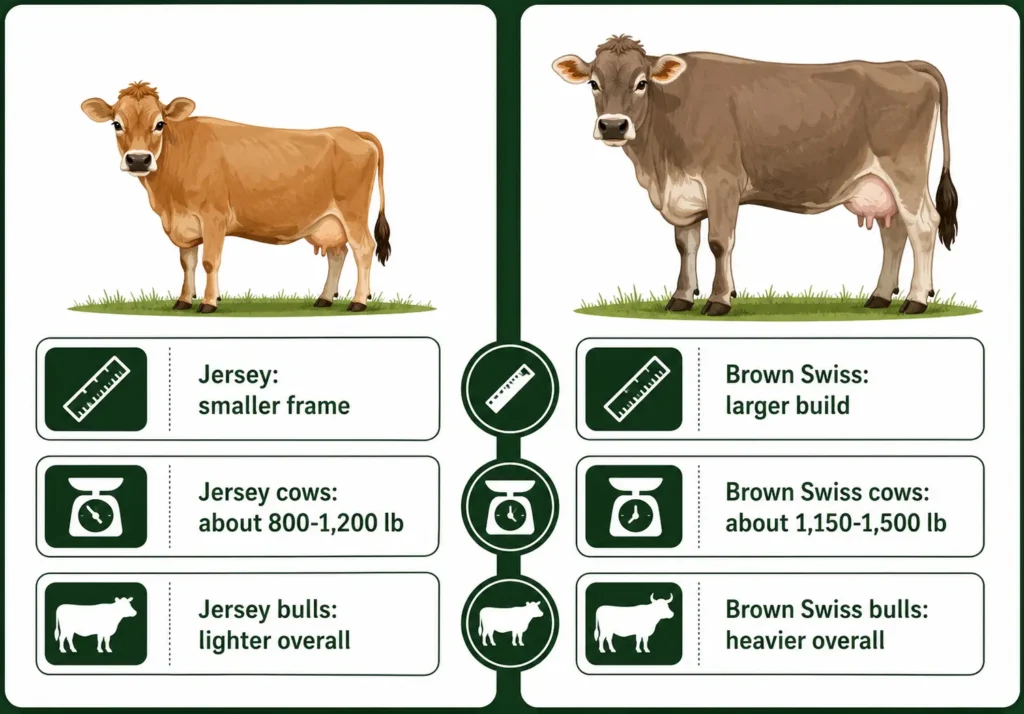
The first difference is easy to spot even if you know almost nothing about dairy cattle.
A Jersey cow is much smaller than a Brown Swiss cow.
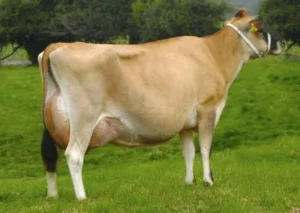
A mature Jersey commonly weighs somewhere around 880 to 1,100 pounds, or roughly 400 to 500 kg. An often-used mature body-weight figure is close to 900 pounds. Brown Swiss cows are quite a bit heavier. Mature females commonly weigh around 1,300 to 1,400 pounds, and some populations average closer to 700 kg, or about 1,540 pounds.
That difference sounds like a simple number, but it affects almost everything else on the farm.
A smaller Jersey takes up less space at a feed bunk. She needs less energy just to keep her body alive each day. Handling equipment can also feel a bit easier to work around because you simply have less cow standing in front of you.
Brown Swiss cows are a different story. They’re big, deep-bodied cattle with a strong frame. A healthy adult Brown Swiss can look pretty massive beside a Jersey.
Does Bigger Mean Better?
Not really.
It depends on your farm.
A Brown Swiss has a bigger body to maintain, but that large frame also supports strong milk production. The breed is well known for sound feet, legs, and durable body structure. That becomes important when a cow spends years walking, standing, eating, getting milked, and carrying calves.
The Jersey goes the other direction. Farmers often like the breed because a smaller body can reduce maintenance needs. In simple words, fewer nutrients go toward keeping a huge body running before the cow even starts putting energy into milk.
Think of it like two trucks. One is small and light. The other is big and heavy. The large truck can carry more, but it also takes more fuel to move itself around.
That’s basically the size difference here.
Milk Production and Daily Milk Yield
Now we get to the big dairy question.
How much milk do they actually give?
In general, Brown Swiss cows produce more total milk than Jersey cows.
Recorded Brown Swiss populations often produce around 8,000 to 10,000 kg during a standard lactation under strong management. One large recorded population reported around 8,100 kg in 305 days, while another breed dataset reported a mature-equivalent figure above 23,000 pounds, which is more than 10,000 kg.
Jerseys normally sit lower in total liquid milk volume.
Recent recorded Jersey populations show how much management and genetics can change the number. One national dataset reported about 7,318 kg per cow, while another recorded population averaged about 7,885 kg over 305 days. Research herds can be lower or higher depending on pasture, concentrate feeding, climate, and genetics.
Daily milk tells the same basic story, but it jumps around a lot.
A cow does not produce the same amount every day from calving until she dries off. Milk normally rises after calving, reaches a peak, and then slowly drops.
One Jersey study, for example, found an average of about 22.6 kg of milk per day across the lactation, with production near 27 kg per day during the early peak before falling later. Brown Swiss references commonly report daily production around 19 to 25 kg in normal dairy systems, while highly selected cows may go much higher.
So don’t turn those numbers into a hard rule.
Feed a poor diet to a genetically strong Brown Swiss and she won’t magically fill the milk tank. Give excellent feed and care to a strong Jersey and she may surprise you.
Milk Volume Is Only Half the Story
This part throws some beginners off.
A gallon of milk is not just a gallon of milk when you’re talking about dairy farming.
Milk contains water, fat, protein, lactose, minerals, and other solids. A cow can give less total liquid but pack more valuable solids into every pound.
That is exactly where Jerseys get interesting.
Butterfat and Protein Content Comparison
If Brown Swiss wins the milk-volume contest most of the time, Jersey usually wins the concentration contest.
Jersey milk is famous for high butterfat.
Typical Jersey milk can contain around 4.8% to more than 5% fat, although herd averages differ. Some modern recorded populations run close to 5%, while selected herds may go well above that. Protein often lands somewhere around 3.8% to above 4%, again depending on genetics, diet, season, and management.
Brown Swiss milk is no watery milk either.
Brown Swiss commonly produces milk around 4% fat, with protein around 3.5% to 3.8%. That combination gives the breed a pretty strong balance between milk quantity and milk solids.
So imagine two buckets.
The Brown Swiss bucket may be bigger.
The Jersey bucket may be smaller, but the milk inside is usually richer.
That richer milk matters when payment depends on pounds of fat and protein instead of only gallons of milk. It also matters for products that depend heavily on milk solids.
One comparison placed Jersey milk around 4.79% butterfat and 3.64% true protein. Another extension reference notes that healthy Jersey herd averages can exceed about 4.9% fat and 3.8% protein.
Brown Swiss still does pretty well here. Around 4% fat and 3.5% to 3.8% protein is nothing to sneeze at.
Basically, Jersey gives you more concentration, while Brown Swiss gives you a strong mix of volume plus useful components.
Temperament and Ease of Handling
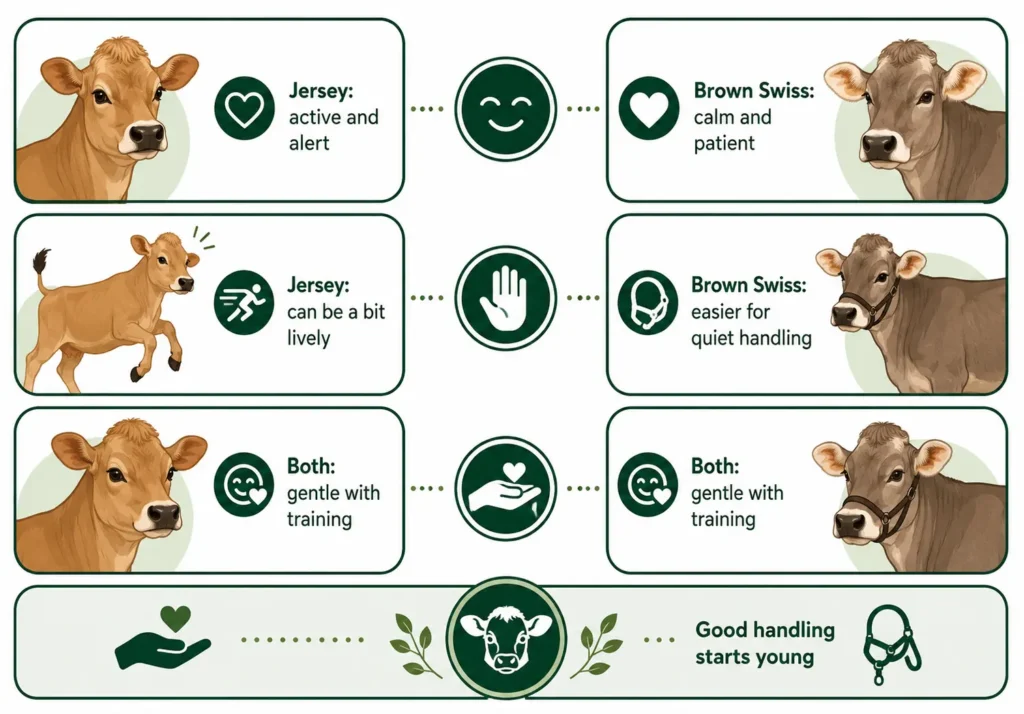
A cow can have beautiful milk numbers on paper and still make your life miserable if she’s difficult to handle.
Temperament matters.
Brown Swiss cattle have a very strong reputation for being calm and docile. They’re often described as quiet animals that don’t get nervous easily. That calm nature can make routine jobs such as moving cows, milking, checking feet, or working around the herd less stressful.
Their size still deserves respect, though.
A calm 1,400-pound cow is still a 1,400-pound cow. If she steps on your foot, the fact that she had friendly intentions won’t help much.
Jersey cows are generally manageable too. They’re often more alert and lively in their movements. Some farmers actually like that sharper, curious personality.
They can learn routines quickly. Good handling from a young age makes a massive difference.
A cow that gets pushed, shouted at, or frightened all the time may become nervous no matter what breed she is. Calm handling, good facilities, non-slip flooring, and predictable routines go a long way.
And there’s one warning worth saying clearly: a dairy bull is not the same thing as a dairy cow. Bulls from dairy breeds can become dangerous, and small body size should never make somebody careless.
For ordinary cow handling, though, Brown Swiss usually gets the edge if your main goal is a naturally quiet, steady temperament.
Feed Requirements and Feeding Costs
This is where Jersey’s small body starts earning points.
Every cow uses part of her food just to stay alive. She has to maintain body temperature, breathe, move around, run organs, digest food, and repair tissue before we even start talking about milk.
A smaller cow usually needs less energy for body maintenance than a larger cow.
That gives Jersey an advantage.
Research comparing Jerseys with larger dairy cattle consistently finds lower dry-matter intake because Jerseys simply don’t have as much body mass to feed. A recent large analysis found Jerseys ate several kilograms less dry matter per day than larger dairy cows in matched studies.
Brown Swiss will generally eat more per head because she’s bigger.
But don’t turn this into “Jersey is cheap and Brown Swiss is expensive.” Farming doesn’t work that neatly.
Brown Swiss can be a very good forage user. The breed has a long history of grazing and working in rougher environments, and breed data often note strong forage conversion and grazing ability.
What Changes the Feed Bill?
Feed quality matters as much as breed.
Cheap poor-quality hay can actually become expensive if the cow can’t eat enough useful energy from it. High-producing animals need protein, energy, fiber, minerals, vitamins, and plenty of water in the right balance.
A lactating cow also needs much more food than a dry cow. A cow making 30 kg of milk obviously needs more nutrients than the same animal making 15 kg.
Then you have body condition.
Overfeeding isn’t a win. A fat cow can face health and calving problems, while an underfed cow may lose too much body weight and struggle with milk production or fertility.
So yes, Jersey usually has the lower total feed requirement per cow.
But calculate feed cost against useful milk output, fat, protein, fertility, and productive life. Looking at the feed bucket alone can throw you off the scent.
Climate Tolerance and Adaptability
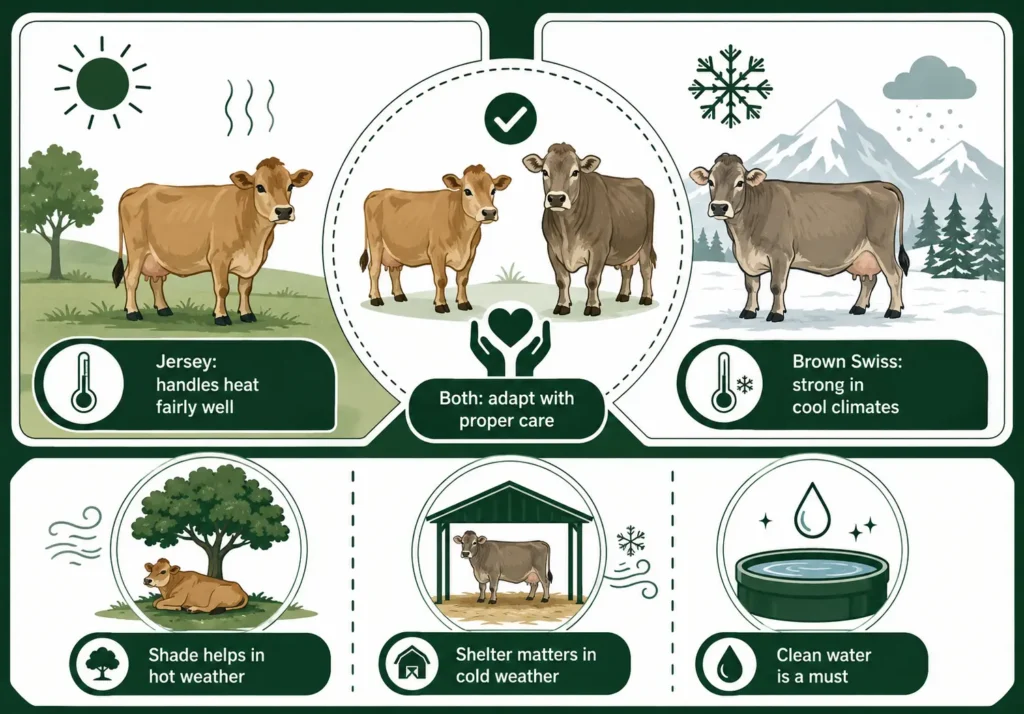
Both breeds are pretty adaptable, but they have slightly different strengths.
Jerseys perform well in warm conditions.
Their smaller body size produces less total metabolic heat, and research on grazing dairy cattle has found evidence of better heat-stress resistance in Jerseys compared with some larger high-producing breeds. Jerseys are also found in dairy systems across hot, mild, and cooler regions around the world.
That doesn’t mean a Jersey can stand in a blazing sun with an empty water tank.
Heat stress can hit any dairy cow.
When temperature and humidity rise, cows may eat less, breathe faster, stand more, produce less milk, and show lower fertility. Shade, clean water, ventilation, and other cooling methods still matter.
Brown Swiss is also known for strong climate adaptability.
The breed developed from cattle used in Alpine areas, so cold conditions don’t scare these big guys much. At the same time, Brown Swiss populations now live successfully in warm regions too. Breed records describe good performance across both hot and cold environments.
Which Handles Heat Better?
If I had to choose only from body size and general breed reputation, Jersey gets a small advantage for hot conditions.
Smaller cattle normally have less body mass producing heat.
But don’t make that your only reason for choosing a breed.
A well-cooled Brown Swiss can outperform a badly managed Jersey. Water availability, shade, airflow, stocking density, coat condition, milk production level, and local humidity all affect heat stress.
Cold weather is a slightly different story.
Both can handle cold with proper nutrition and shelter, but Brown Swiss’s larger body gives it a bit more physical mass. Young Jersey calves may need a little extra TLC in very cold weather because smaller bodies lose heat faster.
Health, Lifespan and Common Problems
There’s no magically disease-proof dairy cow.
Jerseys and Brown Swiss both need clean housing, dry bedding, good nutrition, hoof checks, mastitis control, vaccination plans, parasite management, and quick treatment when something looks wrong.
Still, breed differences do show up.
Brown Swiss has a particularly good reputation for strong feet and legs, durable udders, and productive longevity. That’s a big deal because dairy cows spend a huge amount of time standing and walking. Poor feet can cut a cow’s useful life short even when she has great genetics for milk.
Brown Swiss cows are also known for staying productive across several lactations when properly managed.
Jerseys can also stay productive for years, and their fertility and calving ease are often listed among their useful traits. Their smaller calf size can make calving easier in many cases.
But Jerseys have one health issue farmers need to keep a close eye on around calving: hypocalcemia, commonly called milk fever when it becomes clinical.
Milk production suddenly pulls a lot of calcium from the cow’s blood when lactation starts. Older dairy cows face the biggest risk. Research has repeatedly found Jersey cows to be especially prone to low blood calcium around calving. One large analysis found Jerseys had more than twice the milk-fever risk of Holsteins under the conditions studied. Another study of multiparous Jerseys found a high rate of subclinical low blood calcium after calving.
That doesn’t mean every Jersey gets milk fever. Not even close.
It means transition-cow nutrition needs to be taken seriously.
Diet before calving, magnesium supply, mineral balance, age, previous health problems, milk production, and body condition can all affect risk.
Brown Swiss has its own genetic and health concerns, so buying healthy animals from known lines and using proper breeding records matters. No breed gets a free pass.
Mastitis is another one to watch in both breeds. Clean bedding, good milking hygiene, healthy teat ends, and quick action when milk or udder condition changes make a huge difference.
Longevity is harder to put into one exact number because a cow’s useful life depends heavily on the farm. A genetically sound cow can still leave early because of lameness, infertility, injury, mastitis, or poor management.
So instead of asking, “Which breed lives exactly X years?” a better question is, “Which breed can stay healthy and productive in my system?”
Brown Swiss gets a small edge for its famous structural strength and long productive life. Jersey fights back with lower body size, good fertility, and generally easy calving.
Which Is Better for Dairy Farming: Jersey or Brown Swiss?
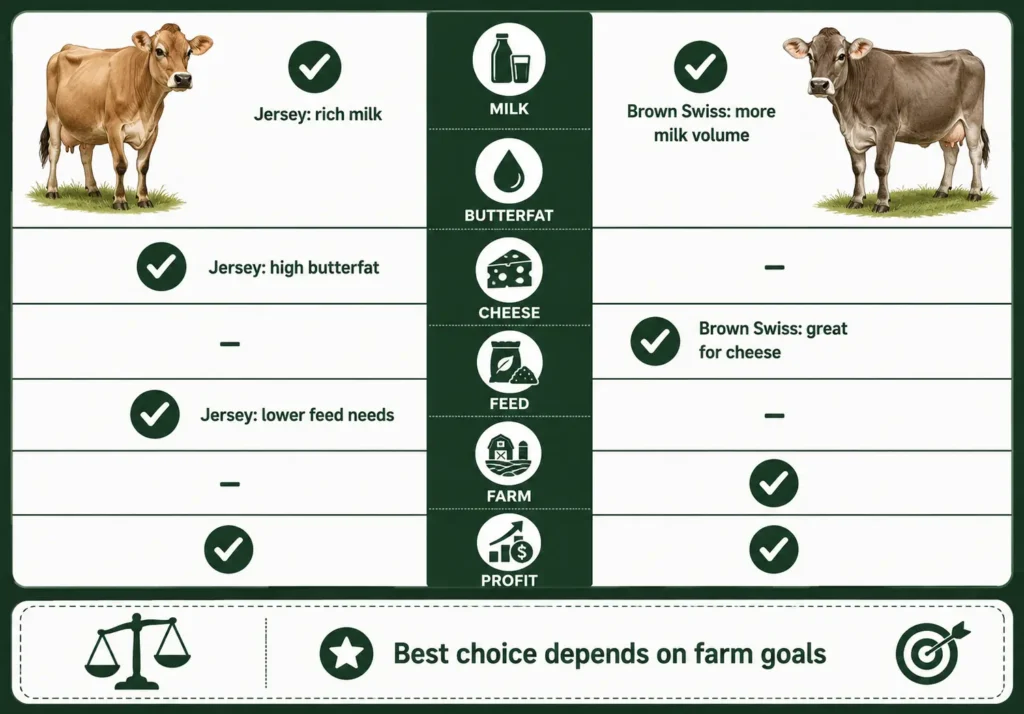
Now for the question everybody actually wants answered.
There isn’t one winner for every dairy farm.
Your winner depends on how you make money.
A Jersey May Be Better If:
- You want a smaller cow with lower maintenance needs.
- Feed and land costs are a major concern.
- You get paid well for butterfat and protein.
- You want very rich milk instead of chasing maximum liquid volume.
- Your farm uses a lot of grazing.
- You live in a warm climate and heat tolerance matters.
- You want to keep more cows in the same general space without moving into a much larger-bodied breed.
Jersey’s biggest trick is pretty simple: she packs a lot of milk solids into milk while carrying a smaller body around the farm.
That can make her very efficient in the right system.
A Brown Swiss May Be Better If:
- You want more total milk from each cow.
- You still want good butterfat and protein levels.
- You value a very calm temperament.
- Strong feet and legs are a major priority.
- You want a larger, durable cow that can stay productive for several lactations.
- Your farm has plenty of good forage available.
- You need cattle that can adapt to different terrain and weather conditions.
Brown Swiss is a bit like the steady worker of the dairy world. Big cow, good milk volume, decent components, strong structure, and usually a calm attitude.
Neither breed makes money automatically.
A poor Jersey herd can lose money. A badly managed Brown Swiss herd can do the same thing.
Feed price, milk price, labor, replacement rate, fertility, disease, land, climate, and milk-payment rules can change the result completely.
If buyers pay mainly for gallons, Brown Swiss’s higher milk volume may look attractive.
If buyers place a lot of value on butterfat and protein, Jersey suddenly becomes very hard to ignore.
Final Thought
The Jersey cow vs Brown Swiss comparison really comes down to one big choice: do you want a smaller, efficient cow with extra rich milk, or a larger, durable cow that usually gives more total milk?
Jersey cows weigh much less. They generally eat less per animal, handle warm conditions pretty well, and produce milk with impressive butterfat and protein levels. Their size can make them especially useful for pasture farms, smaller dairy setups, and systems where feed efficiency and milk components matter.
Brown Swiss cows are the bigger animals. They normally produce more milk volume, yet their milk still carries good fat and protein. Add their calm temperament, strong feet and legs, climate adaptability, and reputation for lasting through several lactations, and you can see why farmers keep coming back to them.
If feed is expensive and rich milk gets rewarded, Jersey may be the smarter choice.
If you have enough feed and want a bigger, calm cow with strong milk volume and good durability, Brown Swiss may fit better.
The number on the milk tank matters, sure, but it’s not the only thing. A cow also has to eat, breed, walk, stay healthy, handle the weather, and keep producing year after year.
That whole picture, not just one impressive milk number is what should decide which breed wins on your farm.