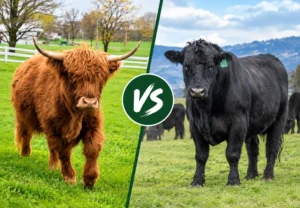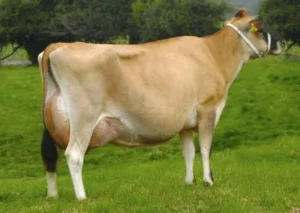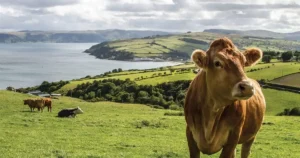
If you look at pictures of Jersey cows online, you may notice something a little confusing. One Jersey has horns. Another one has no horns at all. A third one has tiny bumps where horns should be.
So, do Jersey cows actually have horns?
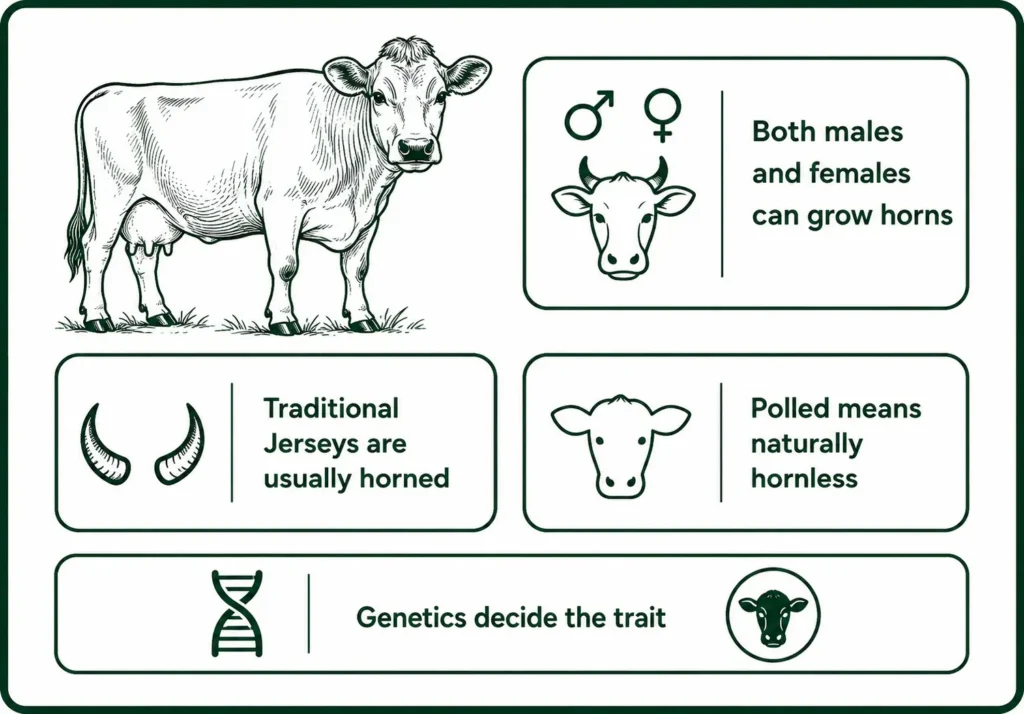
Yes, Jersey cattle can naturally grow horns. Both males and females can have them. But many Jerseys you see today don’t have visible horns because they were born naturally hornless, called polled, or their horn buds were removed when they were young calves.
And one small correction before we go further. People sometimes say “male Jersey cow,” but an adult male cow isn’t really called a cow. A male is a bull, an adult female is a cow, and a young female that hasn’t had a calf yet is normally called a heifer.
Traditional descriptions of Jersey cattle included medium-size, inward-curving horns on females, so horns are not some strange or unusual feature in this breed. Naturally polled Jersey bloodlines also exist today.
That means you can’t simply look at the breed name and say, “Yep, this one will definitely have horns.”
Genetics matters.
Age matters too.
And sometimes farm management changes what you finally see on the adult animal.
Here are the basics:
- Both Jersey bulls and Jersey cows can naturally grow horns.
- A naturally hornless Jersey is called polled.
- Polled genetics can pass from parents to calves.
- Horn buds start developing while the calf is still pretty young.
- Farmers often stop horn growth while calves are young for safety reasons.
- Bulls may develop heavier or thicker-looking horns, but horn length isn’t a perfect way to tell males from females.
- DNA testing and parent information can help tell whether a calf carries polled or horned genetics.
So yeah, there’s a little more going on than “bulls have horns and cows don’t.” That old idea can really throw you off the scent.
| Feature | Horned Jersey | Naturally Polled Jersey |
| Born with horn-growing genetics | Yes | No visible horn growth expected |
| Male can have this trait | Yes | Yes |
| Female can have this trait | Yes | Yes |
| Horn buds may appear when young | Yes | Normally no true horn buds |
| Adult horns possible | Yes, if not disbudded | No true horns |
| Trait affected by genetics | Yes | Yes |
| Can parents help predict it? | Yes | Yes |
| Is DNA testing useful? | Yes | Yes |
Do Male Jersey Cows Have Horns?
First, let’s fix the wording a bit.
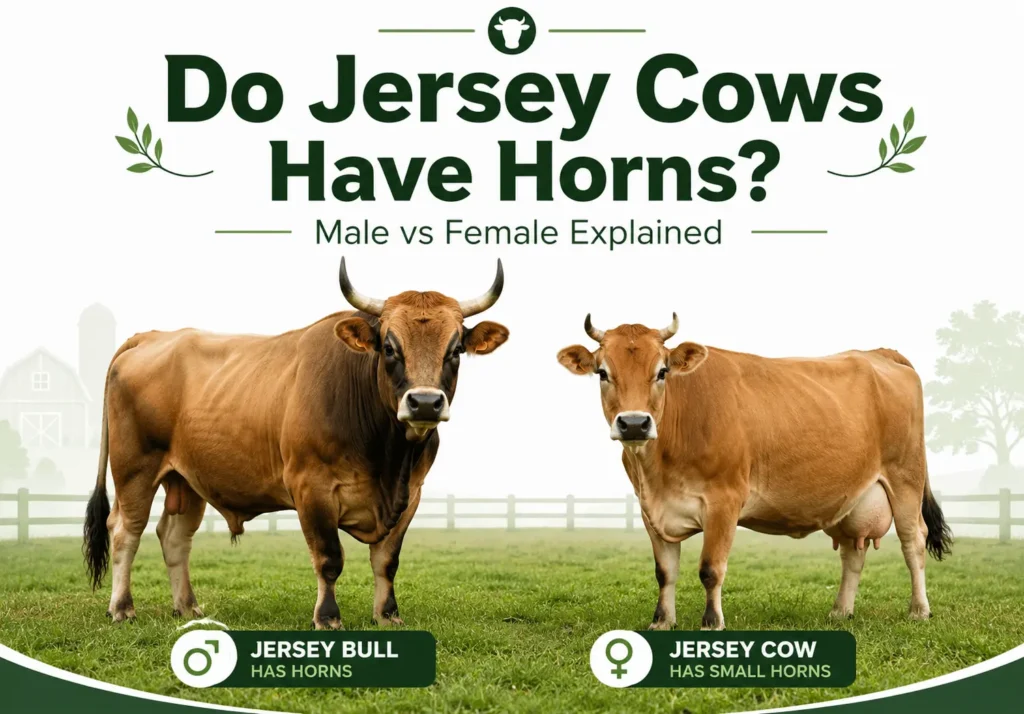
A male Jersey is called a Jersey bull, not a male cow.
And yes, a Jersey bull can naturally grow horns.
If that bull inherited the horned form of the horn-related genes and nobody stopped horn development when he was young, the horns can continue growing as he matures.
Traditional Jersey cattle were not a male-only horn breed. Horns could appear in both sexes.
This matters because some people assume a horned Jersey must be a bull.
Nope.
A horned animal may be male or female.
The Jersey breed itself is fairly small compared with many larger dairy cattle. Mature bulls are still much heavier and more muscular than cows, though. Adult Jersey bulls have traditionally been described in roughly the 1,200 to 1,800 pound range, while cows are commonly much lighter.
That bigger head, stronger neck, and heavier build can also make a bull’s horns look more impressive.
Horns Don’t Tell You the Sex
This is the key bit.
Never use horns alone to decide whether a Jersey is male or female.
Cattle aren’t like some animal species where only the males normally carry horns.
With horned cattle, females can grow proper horns too.
The difference is often more about thickness, shape, base size, and overall build than simply “horns versus no horns.”
Studies of cattle skulls show real differences between male and female horn structures, but they also show something interesting: males don’t automatically have longer horns in every situation. Bulls often have heavier horn bases and wider head measurements, while cows of some cattle types can actually have longer horns.
So don’t get hung up on horn length.
Look at the whole animal.
Do Female Jersey Cows Have Horns?
Yes.
A female Jersey can absolutely grow horns.
In fact, older descriptions of the ideal Jersey cow specifically mention medium-size incurving horns. That tells us pretty clearly that the normal traditional Jersey wasn’t automatically hornless.
The confusion mostly comes from modern dairy farming.
A lot of dairy cattle you see today don’t have horns. So somebody visiting a farm for the first time might think dairy cows just aren’t supposed to grow them.
That’s not really what happened.
Many calves that carry horned genetics have their horn buds treated while they’re young so full horns never develop. Other animals are naturally polled because of their genes.
From the outside, both animals may look hornless.
But genetically they’re not the same.
A naturally polled cow never needed her horn buds removed because she inherited the genetics for being hornless.
A genetically horned cow may look hornless because her horn growth was stopped during calfhood.
Big difference.
A Cow With Horns Is Still Completely Normal
Don’t let horns make you think a female Jersey isn’t pure or that something went wrong.
Horns themselves are not a sign of bad breeding.
Historically, they were a normal part of the breed.
Jerseys have been raised for dairy production for a very long time. They are known for their smaller body size, fawn-to-dark-brown color range, dairy build, high milk solids, and ability to adapt to different environments. Whether a particular animal has horns doesn’t change those basic Jersey traits.
A horned cow can still be a perfectly normal Jersey.
And a polled cow can be a perfectly normal Jersey too.
That’s where genetics gets pretty interesting.
Are Jersey Cattle Naturally Horned or Polled?
Here’s where the answer isn’t just one word.
The traditional Jersey is a horned breed, but naturally polled Jerseys now exist too.
You can even find modern registered Jersey populations where polled animals are specially identified and tracked. If a Jersey calf doesn’t develop horns and meets the parentage requirements, its naturally polled status can be recorded.
So what does “polled” actually mean?
Polled simply means an animal is naturally hornless because of genetics. It doesn’t mean somebody cut its horns off. That’s an important difference. Imagine two adult Jerseys standing next to each other. Neither one has horns. They look pretty similar from a distance.
Cow A was born with polled genetics.
Cow B carried horned genetics, but its horn buds were stopped while it was young.
Both are hornless now, but only Cow A is naturally polled.
The Simple Genetics Behind It
For common European cattle such as Jerseys, polled inheritance is generally treated as a dominant trait.
Let’s keep this school-level simple.
Call the polled version P.
Call the horned version p.
A calf receives one version from its mother and one from its father.
A PP calf is polled.
Pp calf is also polled because the polled trait is dominant.
So the calf is horned.
That’s why a polled animal can sometimes produce a horned calf. A Pp parent looks completely hornless but still carries a horned version of the gene. Breed genetic testing can distinguish horned animals from animals carrying one or two copies of common polled variants.
Let’s say a horned cow is pp and she is bred to a Pp polled bull. On average, about half the calves could be polled and half could be horned.
Now use a PP bull.
Every calf gets at least one P from him, so the calves are expected to be polled under this simple inheritance pattern.
Pretty neat once you see how it works.
At What Age Do Jersey Cow Horns Start Growing?
You usually won’t see a newborn calf walking around with two obvious horns.
Horn development starts much smaller.
Young calves have horn buds.
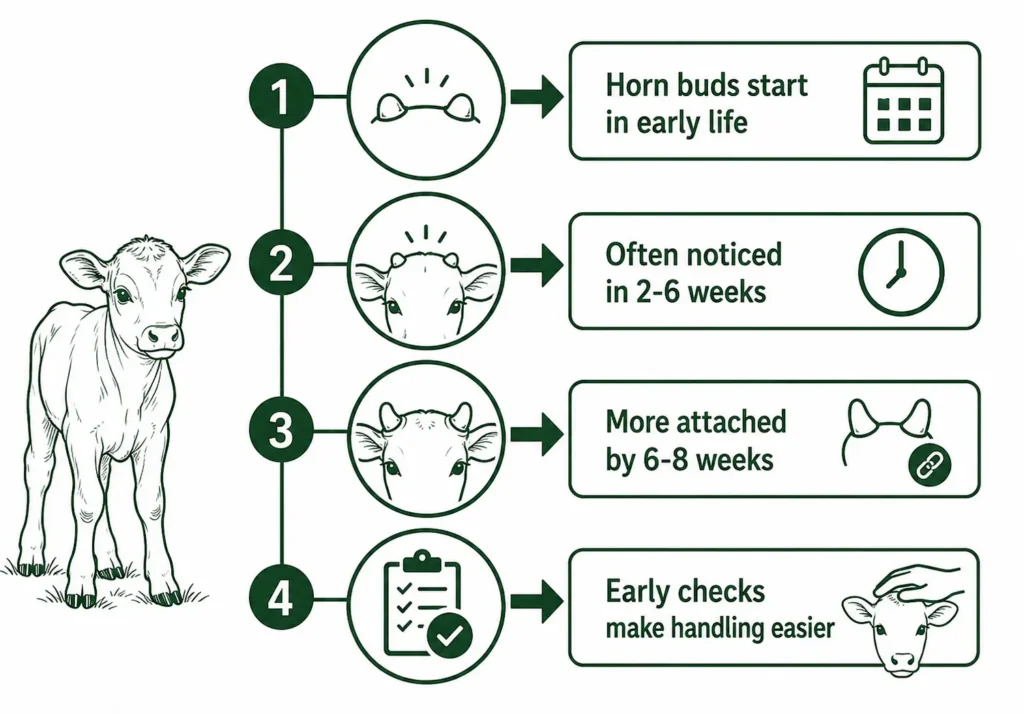
They feel like little firm buttons under or within the skin on the top sides of the head. These little guys start developing early, and farmers normally check young calves during their first several weeks of life.
For roughly the first several weeks, the horn bud has not fully attached to the skull. As the calf grows, that bud attaches to the frontal bone and begins developing into a true horn structure. Guidance on calf care commonly places this attachment period around six to eight weeks, although exact development can vary between calves.
That’s why you hear so much about checking horn buds early.
Waiting months makes everything harder.
Horn Growth Doesn’t Stop After a Few Months
Once real horns start growing, they keep changing as the animal matures. A young Jersey’s horns may begin as small pointed growths.
Later they get longer and stronger. Traditional Jersey horns were described as relatively moderate in size and often curving inward.
Age can change horn size a lot.
Research on cattle skull development shows horn and skull measurements grow rapidly when cattle are young, with growth slowing as the animal reaches adulthood. So don’t compare a one-year-old heifer’s horns with a mature cow and assume something is wrong.
She simply hasn’t finished growing.
It’s a bit like comparing the shoe size of a kid with an adult. Same general body part, very different stage.
Why Are Some Jersey Cows Born Without Horns?
When a Jersey is naturally born without the genetic ability to produce normal horns, we call it polled.
This doesn’t usually happen because the calf is unhealthy. It isn’t because its mother didn’t eat enough minerals. And it isn’t because the horns “forgot to grow.”
It’s mostly genetics.
Polled Jersey cattle have been intentionally bred because many farmers like the practical advantage of cattle that never develop horns.
A polled parent can pass that trait to its calves.
Because polledness works as a dominant trait in standard Jersey genetics, one polled copy can be enough for the animal to show the hornless appearance. That makes selective breeding pretty useful.
Instead of raising a horned calf and later preventing or removing horn growth, breeders can select parents carrying polled genetics.
PP and Pp Are Not Quite the Same
Here’s the part that catches people out. Two polled cows can look exactly the same but carry different genetic combinations.
One might be PP.
Another might be Pp.
The PP animal carries two polled copies.
The Pp animal carries one polled copy and one horned copy.
Both look polled.
But they don’t pass the same mix of genes to their calves. That’s why looking at the animal isn’t always enough. Genetic tests can tell whether an animal carries horned or common polled variants, which helps breeders predict future calves more accurately.
There’s another little thing called scurs.
Scurs are small horn-like growths that may appear in some polled cattle. They aren’t the same thing as normal attached horns, and the genetics behind scurs are separate from the main polled gene.
So if you see a weird little loose horn-like bit, don’t immediately decide the animal isn’t polled. Cattle genetics loves throwing in little surprises like that.
Why Do Farmers Dehorn Jersey Cattle?
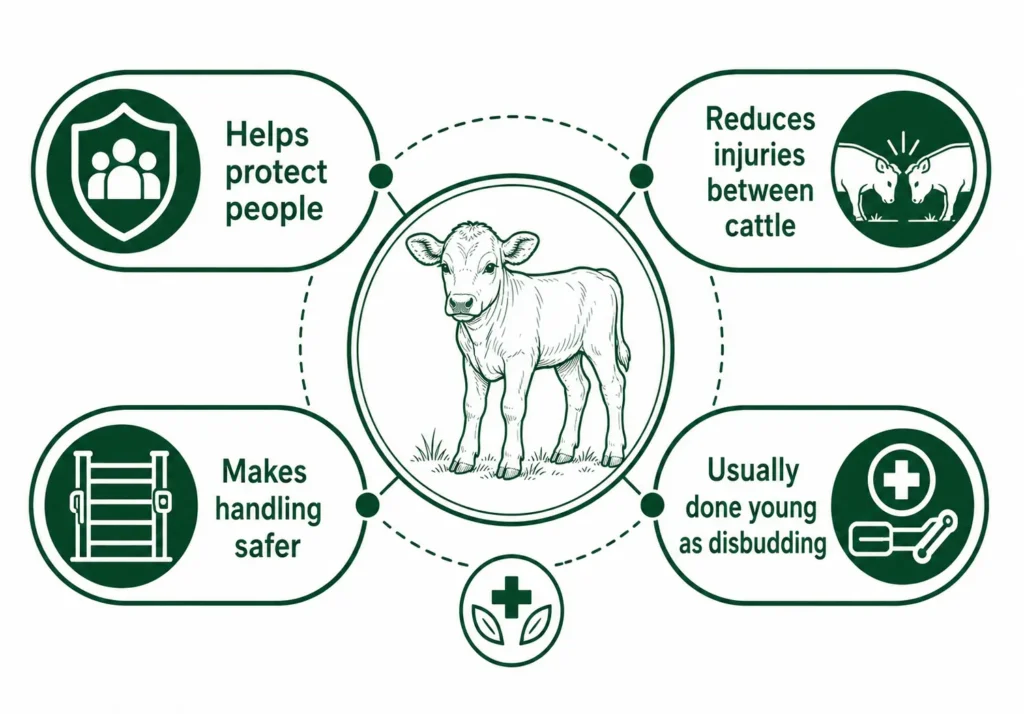
The biggest reason is pretty simple.
Safety.
A Jersey might be smaller than a huge beef animal, but don’t let that fool you. An adult cow can still weigh around 1,000 pounds, give or take, and a mature bull can weigh considerably more. Add two pointed horns to a big moving animal and accidents can happen.
Horns can injure another cow during pushing, feeding, transport, or normal herd arguments.
They can hurt workers too.
A cow doesn’t even need to attack somebody.
She might turn her head quickly while a person stands beside her.
That’s enough.
Horns may also increase problems with bruising and injuries when animals crowd together or move through handling equipment. Research from cattle quality surveys has linked horn presence with concerns about bruising.
This is why many dairy farms prevent horn development while calves are still young.
Disbudding and Dehorning Aren’t Exactly the Same
People often use these words like they mean the same thing.
Technically, there’s a difference.
Disbudding means stopping horn development while the horn bud is still young and hasn’t firmly attached to the skull.
Dehorning generally means removing a horn after more developed horn tissue has formed and attached.
Early disbudding is preferred over waiting for a large horn because later procedures become more invasive.
Modern cattle welfare guidance also makes something else super crucial: horn removal is painful, so proper pain control and veterinary guidance matter.
Current livestock guidance recommends pain-management plans and encourages dealing with horn buds while calves are young rather than waiting until a big horn has developed.
This isn’t really a “grab a tool and do it yourself” job.
A veterinarian or properly trained livestock professional should guide the process, especially once the calf is older.
And this is one reason polled genetics gets so much attention.
If the calf never grows horns in the first place, there is no horn-removal procedure to worry about.
Do Jersey Bulls Have Bigger Horns Than Females?
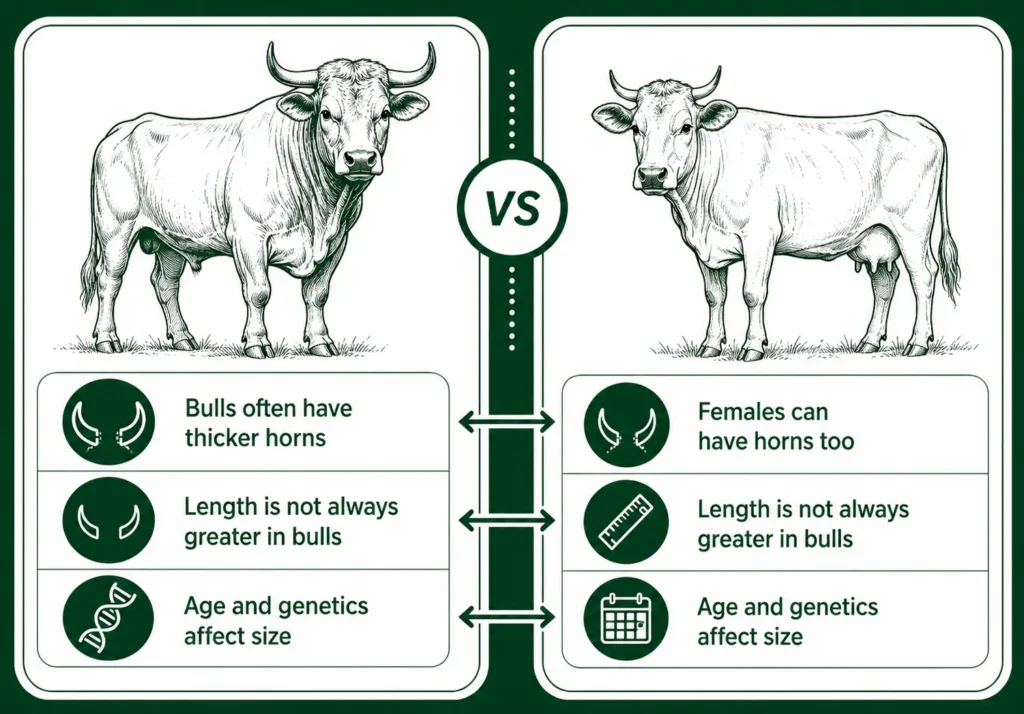
Usually, Jersey bulls can develop heavier-looking and thicker horns, especially around the base.
But here’s where people oversimplify things.
A bull does not automatically have longer horns than a cow.
Research on cattle skulls shows sex affects horn structure. Bulls tend to have broader skull dimensions and thicker or larger horn bases in several cattle populations. Yet horn length doesn’t follow one perfect male-bigger-than-female rule. Some research even found that cows could have longer horns than bulls within the same breed while bulls had heavier horn cores.
So imagine a bull with thick, strong-looking horns.
Next to him is a cow with thinner but slightly longer horns.
Nothing weird there.
Horn appearance depends on several things sex, age, genetics, bloodline, nutrition, and whether the animal was allowed to keep growing its horns. A mature bull also has a much heavier head and neck than a cow.
That makes his horns look chunky even when they aren’t dramatically longer.
Don’t Sex Jersey Cattle by Horn Size
This sounds obvious after everything we’ve covered, but it’s worth repeating. Don’t look at a Jersey with big horns and say, “Definitely a male.” And don’t look at a hornless Jersey and say, “That must be a female.”
Both guesses can be completely wrong. Male and female Jerseys can be horned.
Male and female Jerseys can also be naturally polled.
Horn appearance gives you information about genetics and management, but it isn’t a dependable sex test.
How Can You Tell if a Jersey Cow Will Grow Horns?
If you have a young Jersey calf, there are a few pretty good clues.
Sometimes it’s easy.
Sometimes you need more information. The best approach is to combine what you see with what you know about the parents.
Here are the main checks:
- Look at the parents. If both parents are genetically horned, the calf will normally inherit horned genetics. If a parent is polled, the calf may also inherit polledness.
- Check the pedigree. Registered records may show whether parents or grandparents are polled.
- Feel for horn buds while the calf is young. Horned calves develop small firm buds on the top sides of the head during early life.
- Watch the first several weeks carefully. Horn buds become easier to notice as the calf grows, especially before about six to eight weeks.
- Don’t judge from hair alone. Jersey calves can have fuzzy heads, and thick hair may hide tiny buds.
- Consider genetic testing. A DNA-based horned/polled test can identify common genetic variants linked with natural polling.
- Remember scurs exist. Small loose horn-like growths are not necessarily true horns.
- Ask a livestock veterinarian when you’re unsure. A professional can tell the difference between a true horn bud, scur, old disbudding site, or other bump.
Genetic testing gives you a particularly useful answer when breeding matters.
For example, simply seeing that a bull is polled can’t tell you whether he is effectively carrying two polled copies or one polled and one horned copy.
That difference can completely change the chances of getting horned calves.
Modern Jersey genetic programs specifically offer horned/polled testing because appearance doesn’t give breeders the whole story.
Physical checking still works well for everyday calf care.
If the little bumps start becoming firm, obvious horn buds, you’ve got a pretty good indicator that the calf is heading toward normal horn development.
Just don’t wait forever to figure it out. By around six to eight weeks, horn buds are beginning to attach more firmly to the underlying skull, and management becomes more complicated after that point.
Final Thought
So, do Jersey cows have horns?
Yes.
Traditional Jersey cattle are capable of naturally growing horns, and that includes both males and females.
A Jersey bull can have horns. Jersey cows can have horns. A Jersey heifer can start growing horn buds while she’s still a tiny calf.
But that’s only half the story now.
Naturally polled Jerseys also exist, which means some animals inherit genes that prevent normal horn growth. Because polledness is dominant in the usual inheritance pattern for Jerseys, a calf only needs one common polled copy to show a naturally hornless appearance.
Then we have farm management.
A genetically horned Jersey may never grow visible adult horns because its horn buds were treated while it was young. So when you walk through a dairy herd and see fifty cows without horns, don’t assume all fifty are naturally polled.
Some may be.
Others may simply have been disbudded as calves.
And male versus female? Horns won’t solve that puzzle for you either.
Both sexes can have them. Bulls often develop heavier heads, thicker horn bases, and a more powerful overall look, but females can still grow long and obvious horns. Research on cattle even shows that longer doesn’t always mean male.