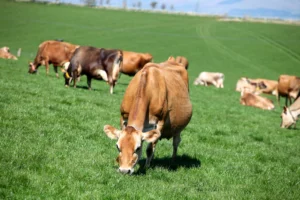
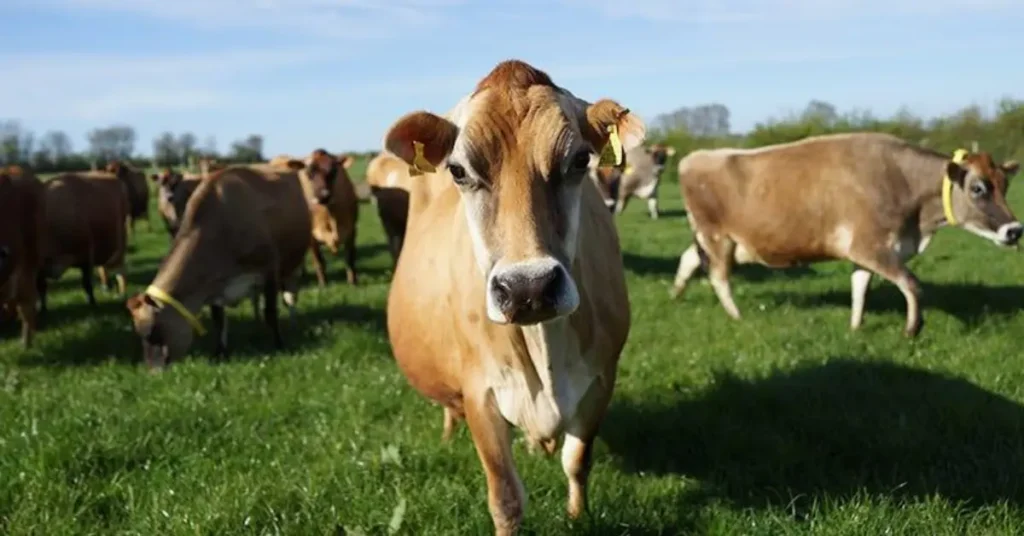
A Jersey cow’s milk per day is not one fixed number. One cow may give a moderate amount of milk with very high butterfat. Another may produce much more because she has stronger genetics and better feed. Her age also matters. So do heat stress and water access.
Official Canadian milk records for 2025 show an average production of 7,563 kilograms of milk per Jersey cow. Jersey milk in those records averaged 5.28% fat and 3.96% protein. When that milk total is spread across a standard 305-day lactation it works out to roughly 24.8 kilograms per milking day. Spread across the whole calendar year it equals about 20.7 kilograms per day. These are rough calculations rather than a promise for every cow.
For simple farm planning a well-managed Jersey may therefore average around 20 to 25 kilograms of milk on each lactating day. Peak production can rise above this level. A first-calf heifer may stay below it. A family cow milked once daily may also give less saleable milk than a commercial Jersey milked two or three times.
A cow sharing milk with her calf will leave less in the bucket. That does not always mean she has poor production. Part of her milk simply went to the calf before milking.
The table below shows how production normally changes through one lactation.
| Lactation stage | Approximate period | Usual production pattern |
| Fresh period | First 1 to 14 days | Milk rises quickly after colostrum |
| Early lactation | 14 to 100 days | Production climbs toward its peak |
| Peak period | Usually 45 to 90 days | Highest daily yield is recorded |
| Mid-lactation | 100 to 200 days | Milk should remain fairly steady |
| Late lactation | 200 to 305 days | Production slowly declines |
| Dry period | About 45 to 60 days | Milking stops before the next calf |
A cow’s lactation generally lasts close to 300 or 305 days. Mature cows usually reach peak production earlier than first-lactation animals. First-calf heifers tend to climb more slowly but may hold their milk more steadily later in lactation.
Average Jersey Cow Daily Milk Yield
A useful average is about 20 to 25 kilograms per day during lactation for a Jersey in a good recorded herd. However, that figure needs some explanation.
It does not mean every Jersey walks into the parlor and gives exactly that amount each morning. A herd average mixes high-producing mature cows with young heifers and late-lactation animals. It may also include cows recovering from illness or preparing to dry off.
A fresh cow can start below her later daily yield. Her milk then rises during the first weeks after calving. At peak lactation she may produce well above the herd average. Months later her production slowly falls.
The farm system also changes the result. A pasture-based Jersey may produce less liquid milk than a cow receiving a carefully balanced total mixed ration. Yet the pasture cow may still give profitable milk if feed costs stay low.
A homestead Jersey often produces differently from a registered commercial cow. The family cow may be milked once a day. She may raise her calf. Her owner may not push her toward maximum yield. In that case the household could collect much less milk even though the cow remains healthy.
A high daily number is not always the best result. A cow that gives a large amount for a short time and then suffers fertility or hoof problems may be less useful than a cow with moderate and steady production.
I like to look at three numbers together. The first is daily milk. The second is butterfat and protein. The third is how long the cow stays productive. Jersey cows often look stronger when all three numbers are considered.
Jerseys were developed for milk with valuable solids rather than plain water volume. This is why comparing them only with the total liters from a Holstein can give the wrong picture. The Canadian records show lower milk volume for Jerseys than Holsteins but clearly higher fat and protein percentages.
Peak Milk Production During Lactation
Peak milk means the highest recorded daily milk production during early lactation. It gives the farmer a quick view of how well the cow moved through the dry period and calving.
Most dairy cows reach peak production between 45 and 90 days in milk. Some mature cows peak earlier. First-lactation cows often reach their highest level later. A Jersey does not reach peak milk on the day she calves. Her body needs time to increase milk production. Her feed intake must also rise.
This creates a tough period. Milk demand can climb faster than the cow’s appetite. She may use some stored body fat to support production. This is called negative energy balance.
A little body-condition loss can happen in early lactation. Too much loss is a warning. The ration may lack enough energy. The cow may also have a health problem that reduces appetite.
Peak production matters because it can shape the whole lactation. University of Minnesota Extension notes a common dairy guideline that each additional pound of peak milk may be linked with another 200 to 250 pounds of milk across the full lactation. It is a management guide and not a guarantee for every animal.
Strong peak milk starts before calving. A cow needs a good dry period. She should enter calving at the right body condition. She also needs comfortable housing and enough feed-bunk space.
After calving the fresh cow needs fast access to water and a fresh ration. Low calcium and other transition problems can cut appetite. Ketosis and metritis can also pull production down before the cow reaches her potential.
Chasing a giant peak can backfire. The goal is a healthy peak that the cow can support. A cow that reaches a huge number and then crashes has not given the farmer a good lactation.
The better curve rises smoothly. It reaches a solid peak. It then falls slowly rather than dropping in a sharp line.
First-Lactation Jersey Cow Milk Output
A first-lactation Jersey is still growing. She must use nutrients for her body and her milk at the same time. That is one reason she often produces less than an older cow.
Mature cows may produce around 25% more milk at peak than first-lactation cows in the same herd. Young cows also tend to reach their peak later. Their lactation curve may remain more persistent through the middle and later months.
This makes a first-calf heifer easy to judge too harshly.
Suppose a mature cow peaks at 28 kilograms per day. A younger cow from the same general group might peak nearer 21 kilograms. That is only an example based on the 25% difference. It is not a breed rule.
The young cow could improve greatly in her second and third lactations. Her udder capacity and body size continue developing. She also becomes more familiar with the milking routine.
Social pressure can reduce her feed intake. An older cow may push her away from the bunk. A nervous heifer may spend less time resting when placed with large dominant cows.
Separate first-lactation groups can help. University of Minnesota Extension says young cows often do better when grouped together for social and nutritional reasons. Their rations must support both milk production and continued growth. A first-calf Jersey also needs patience in the parlor. The sounds and equipment may be new. Rough handling can create fear. A stressed heifer may kick or hold back milk.
Calm routines work better. Let her enter without shouting. Keep the floor safe. Check that the milking unit fits and does not pull on the udder. Her first-lactation milk record should be viewed as the beginning of her dairy career. It shows useful information but it does not always reveal her mature potential.
Feed and Water Needs for Better Milk Yield

A Jersey cannot make good milk from poor feed simply because she is an efficient breed.
Jersey Canada describes Jerseys as strong feed converters. Its feeding guidance gives an example of a 450-kilogram Jersey consuming up to 20.25 kilograms of dry matter per day while in production. Actual intake changes with body weight and milk yield. Weather and forage quality matter too.
Dry matter means the feed left after water is removed. Fresh grass and silage may look heavy because they contain moisture. A cow can appear to eat a large pile while receiving too little actual dry matter.
The ration should provide enough energy without removing useful fiber. Too little energy limits milk. Too much fast grain can damage rumen health and lower butterfat.
A practical Jersey feeding check includes:
- High-quality forage with enough digestible energy
- Effective fiber to support chewing and rumen function
- Balanced protein for milk and body repair
- Correct minerals for calving and metabolic health
- Fresh feed that is available for most of the day
- Enough bunk space so timid cows can eat
- Unlimited clean water close to the feeding and milking areas
Water deserves just as much attention as feed. A lactating dairy cow may drink around 30 to 50 gallons of water per day. Hot weather can raise demand further. Jerseys are smaller than many dairy cows so an individual may drink less than a large Holstein. A high-producing Jersey in summer can still need a large amount.
Cows often drink a big part of their daily water soon after milking. A clean trough near the parlor return lane can support intake.The trough must refill quickly. A cow should not wait while water enters through a slow pipe. Water should also taste and smell clean. Algae and manure can reduce intake.
Small feed changes can show up in the milk tank. Wet silage may suddenly contain less dry matter than expected. If the farmer feeds the same weight without testing moisture the cows receive less nutrition.
That is why good dairy feeding includes observation. Watch body condition and manure. Look for feed sorting. Track daily milk. A falling tank is often an early sign that something changed.
Jersey Milk Butterfat and Protein Levels
Jersey milk is known for high components.
Canadian official records for 2025 reported 5.28% butterfat and 3.96% protein in Jersey milk. Holsteins produced more total milk but averaged 4.21% fat and 3.38% protein in the same records.
Butterfat gives milk a rich taste. It also supports butter and cream production. Protein plays a major role in cheese making because it helps form the curd.
A Jersey may therefore earn good value without matching a Holstein’s daily milk volume. This matters when processors pay by kilograms of fat and protein. Jersey Canada calls the breed a strong component producer. It reports that Jersey milk can produce more butter and cheese than average milk because of its concentrated composition.
Milk components still change from day to day.
Butterfat may fall when the ration lacks effective fiber. Fine feed particles and heavy grain intake can upset rumen fermentation. Feed sorting may create the same problem.
Protein often responds to energy intake. A cow that lacks usable energy may struggle to produce strong protein levels even when the ration contains plenty of crude protein.
The stage of lactation changes the percentages too. Milk volume may be high near peak while fat percentage looks lower. Later in lactation the cow may give fewer liters with a higher concentration of solids.
One test should not define the cow. Farmers should follow the trend over several milk tests. A sudden drop across the herd usually points toward feed or heat. A change in only one cow may suggest illness or an individual problem.
For a family cow the rich milk can create a thick cream line. That is great for butter and ice cream. It may be more cream than a household expects. Jersey’s real strength is not only how much milk fills the bucket. It is what that milk contains.
How Heat and Seasons Affect Daily Production
Summer heat can pull milk production down before the cow looks seriously sick.
Heat stress begins when a cow creates and absorbs more heat than she can release. Digestion and milk production both create body heat. Sunlight adds more.
University of Minnesota Extension says mild heat stress can begin around 72°F with 50% humidity. High-producing cows may feel stress at even lower temperatures because they eat more and create more internal heat. The first sign may be faster breathing. The cow may stand longer and eat less. She may gather near water or shade.
Milk loss can appear a couple of days after the heat begins. This delay can fool the farmer. The weather may feel cooler when the milk tank finally drops. Shade and airflow help. Fans should move air across resting cows and holding areas. Sprinklers can support cooling when the system allows water to evaporate.
Water access becomes even more important in summer. Every cow should be able to drink without waiting behind dominant animals.
Jerseys often have a good reputation in warm regions. Their smaller bodies may help them release heat. They still need cooling. A high-producing Jersey can suffer badly when humidity stays high.
The season also changes the feed. Spring pasture may be lush and high in protein but low in useful fiber. Mature summer grass may become tough and less digestible. Winter forage may vary from one stored batch to another.
Cold weather can affect production in another way. Frozen or very cold water can reduce drinking and feed intake. Water systems must remain open and easy to reach. Day length may also influence activity and farm routines. Yet feed quality and temperature usually create the clearest seasonal changes on a small dairy.
The best defense is good records. Write down milk yield and weather. Add ration changes and health events. Patterns become easier to see after a few weeks.
Reasons a Jersey Cow Produces Less Milk
Low milk does not always mean the cow has bad genetics. The cause may be completely normal. A late-lactation cow should not produce like a fresh cow near a peak. The farmer should first check days in milk and age. Then look at feed and water. Health and milking routines come next.
Common reasons include:
- Late lactation because yield naturally declines as the dry period approaches
- First lactation because a young cow is still growing and has less mature capacity
- Poor energy intake from weak forage or an unbalanced ration
- Limited or dirty water that lowers feed intake and milk production
- Heat stress that reduces appetite and raises the cow’s cooling needs
- Health problems such as mastitis ketosis milk fever metritis lameness or digestive trouble
- Milking issues such as missed milkings poor machine function stress or incomplete milk removal
Early-lactation health problems can greatly reduce peak milk. Low fiber and feed sorting may contribute to rumen acidosis. Metabolic disease can reduce appetite at the exact time the cow needs the most nutrients. Crowding can also lower performance. A timid Jersey may spend less time eating or resting when placed with aggressive cows. Fresh cows need room at the feed bunk and comfortable stalls so they can recover after calving.
mastitis may reduce milk from one quarter before the cow shows obvious pain. Check the udder for heat and swelling. Watch the milk for clots or unusual color. Somatic cell records can reveal hidden udder trouble.
Lameness also affects the tank. A sore cow walks less and visits the feed bunk less often. She may stand for long periods because lying down and rising hurt.
Milking equipment deserves attention. Poor vacuum settings can make cows uncomfortable. A slipping unit may leave milk behind. Rough treatment in the parlor can make a nervous Jersey refuse to let down milk fully.
Sudden drops need quick action. Compare today’s total with the cow’s normal level. Check temperature and appetite. Look at manure and rumination. Inspect the udder and feet.
A slow decline across several months may be normal lactation. A sharp decline over one or two milkings deserves a closer look.
Final Thought
The best practical answer to Jersey cow milk per day is about 20 to 25 kilograms during a well-managed lactation. Some cows will produce less. Strong mature Jerseys can peak much higher.
Daily yield changes with age and days in milk. First-calf heifers usually produce less than mature cows. Peak production often arrives between 45 and 90 days after calving. Young cows may reach it later. Feed and water decide how much of the cow’s genetic ability reaches the milk tank. High-quality forage matters. Clean water matters just as much.
Jersey milk also carries more value than its volume alone suggests. Its high butterfat and protein make it useful for cream and butter. It also works well for cheese and other dairy products.
Do not judge a Jersey by one day’s milk. Watch her whole lactation. Follow her components and body condition. A healthy cow with steady production is usually worth more than one huge number on a single morning.