Highland cow calves grow at a steady rate, but they are not usually pushed to grow as fast as some large commercial beef breeds. They are hardy cattle built for rough land, cold weather, and pasture-based living. A healthy Highland calf can gain around 0.8 to 1 kg, or about 1.8 to 2.2 pounds, per day when milk, grass, weather, and health conditions are good. Calves raised mainly on rough pasture may grow more slowly.
Growth also changes with age. A calf grows quickly while drinking milk from its mother, then may slow down for a short time around weaning. After that, grass quality, extra feed, genetics, sex, parasites, and general health have a bigger effect.
Highland cattle also mature more slowly than many modern beef breeds. A calf that looks small at one year old still has plenty of growing left to do. Mature Highland cows commonly reach around 500 kg, while mature bulls can reach about 800 kg under good conditions.
The table below gives a simple idea of how Highland calf growth may look. These are useful estimates, not strict target weights for every animal.
| Age | Approximate Weight | Main Growth Stage |
| Birth | 24–35 kg (53–77 lb) | Newborn stage |
| 1 month | 35–55 kg (77–121 lb) | Heavy milk feeding |
| 3 months | 70–110 kg (154–243 lb) | Milk plus early grazing |
| 6 months | 130–180 kg (287–397 lb) | Strong pasture growth |
| 9 months | 170–230 kg (375–507 lb) | Weaning or post-weaning |
| 12 months | 220–320 kg (485–705 lb) | Yearling growth |
| 18–24 months | Varies widely | Young adult development |
| Mature | Cows around 500 kg; bulls around 800 kg | Full adult body size |
The exact weight can fall above or below these ranges. A calf growing steadily and staying healthy matters more than hitting one exact number.
Highland Calf Weight at Birth
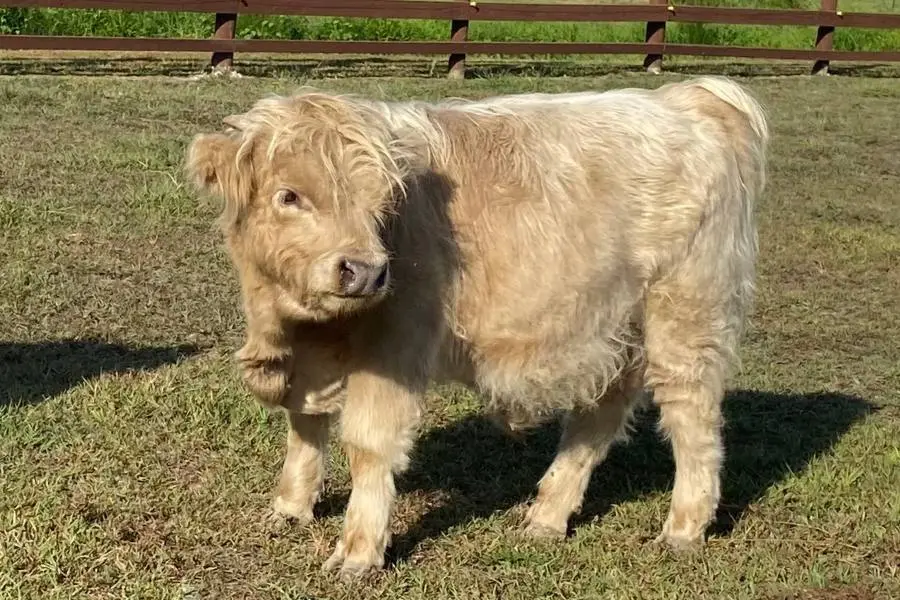
Highland calves are usually fairly small at birth compared with calves from some heavier beef breeds. Research involving hundreds of Highland births found average birth weights of about 24 kg for female calves and 25 kg for male calves. Other Highland herds may produce calves closer to 25 to 35 kg, so genetics and management can create a noticeable difference.
Smaller birth size is useful because it can make calving easier. Highland cows are known for being strong mothers and commonly give birth without a lot of help. Birth weight still needs to stay balanced, though. A calf that is unusually tiny may struggle to stay warm, stand, or drink enough milk. A very heavy calf can increase the chance of a difficult birth.
Sex has a small effect from the start. Bull calves are often slightly heavier than heifer calves, although there can be plenty of overlap between the two.
The size of the mother also matters. A mature cow with good nutrition may produce a bigger calf than a young heifer having her first baby. The bull’s genetics can affect birth size as well.
Nutrition during pregnancy should support steady fetal growth without making the cow too fat. Poor nutrition may reduce calf strength and growth, while badly managed overfeeding can create its own problems.
After birth, weight alone should not be the only thing checked. A healthy newborn should become alert, try to stand, find the udder, and begin nursing.
What Matters More Than Birth Weight?
A good start includes several things:
- The calf stands and nurses soon after birth.
- It receives enough colostrum during its first hours.
- Its body stays warm and dry.
- Its navel looks clean and healthy.
- The cow accepts and feeds the calf.
- The calf becomes active and responsive.
A 24 kg calf that nurses strongly may do better than a heavier calf that cannot stand or drink properly.
Average Daily Weight Gain of Highland Calves
Average daily gain, often called ADG, tells you how much body weight a calf adds each day.
The formula is simple:
Average Daily Gain = Weight Gained ÷ Number of Days
Suppose a Highland calf weighs 30 kg at birth and reaches 150 kg at 180 days.
It gained:
150 – 30 = 120 kg
Now divide 120 kg by 180 days:
120 ÷ 180 = 0.67 kg per day
That calf averaged about 0.67 kg, or 1.48 pounds, of gain each day.
Under suitable conditions, Highland calves can gain around 0.8 to 1 kg per day without heavy extra feeding. Data from pasture-based Highland systems also show gains around 0.75 kg per day for pure Highland calves.
This does not mean every calf should gain exactly that amount.
Some may gain 0.6 kg per day and remain perfectly healthy. Others on rich pastures with a high-milking mother may come close to 1 kg per day for part of the growing season.
Daily gain can change through the year too. A calf may grow quickly during spring when grass is rich, then gain more slowly during winter.
Weather plays a role because a calf uses energy to maintain body temperature. Very cold conditions can reduce growth when the animal does not have enough feed energy to cover both maintenance and weight gain. Research in young calves has shown a clear link between environmental temperature and daily growth.
Do not judge growth using only one day’s weight. Gut fill, water intake, and feeding time can move the scale up or down. Weighing every few weeks gives a much better picture.

Highland Calf Growth by Month
Highland calf growth is not a perfectly straight line.
The first year can be divided into several stages because the calf’s source of nutrition changes as it grows.
Birth to 1 Month
During the first month, milk does most of the work.
The calf starts life depending heavily on its mother. Good colostrum during the first hours helps protect it against disease. After that, regular milk supports early muscle, bone, and organ growth.
A strong calf spends much of its time nursing, resting, and following its mother. You may also notice it tasting grass surprisingly early. It is not getting most of its nutrition from grass yet. The behavior helps the digestive system begin preparing for solid feed.
Early growth can vary widely. A good milk supply from the mother makes a big difference during this stage.
1 to 3 Months
By two or three months, the calf becomes much more active.
It still drinks plenty of milk, but grass starts playing a larger role. The rumen, which is the large fermentation part of a cow’s stomach, continues developing. This period often brings steady growth because the calf has two useful food sources: milk and pasture.
Good-quality pasture can make a noticeable difference. Young grass usually contains more useful protein and energy than old, dry grass.
The calf should also have clean water available even though it is still nursing.
3 to 6 Months
Growth often becomes easier to notice between three and six months.
The calf becomes taller, longer, and heavier. Its chest develops, legs thicken, and the body begins looking less like a newborn.
Milk still helps, but grass intake becomes much more important.
If pasture quality drops during summer or dry weather, growth can slow. The cow’s milk production may also begin falling as the calf gets older.
By six months, healthy standard Highland calves may commonly weigh somewhere around 130 to 180 kg, although some can fall outside this range depending on their starting weight and daily gain.
6 to 9 Months
This is an important period because many calves move toward weaning.
Their digestive system can now handle much more forage. Pasture, hay, silage, minerals, and any supplied feed start having a bigger effect on body weight.
Some calves show very good growth during this stage. Others slow slightly as milk intake drops.
Growth should still continue over time. A calf that completely stops gaining weight for a long period needs attention.
9 to 12 Months
By the time a Highland reaches one year old, it is clearly a young animal rather than a small baby calf.
The body develops more muscle and bone, but Highlands are still far from their mature size at this age.
Genetic programs in cattle commonly measure yearling weight at about 365 days because it gives breeders useful information about growth potential.
Good yearling growth does not require making the animal fat. A well-developed frame, steady weight gain, bright appearance, and normal movement are more useful signs.
Highland Calf Weight at 6 Months
Six months is a useful age for checking Highland calf growth.
A standard Highland calf may weigh roughly 130 to 180 kg, or around 285 to 400 pounds, by this stage under normal conditions. Some well-grown calves may weigh more, while calves raised on poor hill pasture may weigh less.
Rather than looking at the six-month number alone, compare it with birth weight.
For example, imagine two calves.
Calf A was born at 26 kg and weighs 150 kg at six months.
Calf B was born at 32 kg and weighs 155 kg.
Their six-month weights look similar, but Calf A has added more weight compared with its starting size.
This is why growth records can tell you more than a single scale reading.
Around 205 days is also commonly used as a standard point for comparing weaning weight in cattle performance records.
A six-month Highland calf should normally look strong rather than fat. You should be able to see that the body has filled out, but an extremely heavy layer of fat is not necessary.
Its coat can make visual checks harder. Highland cattle have thick hair, so a skinny calf may look fuller than it really is. Putting a hand over the ribs, spine, hips, and loin gives a better idea of body condition.
Highland Calf Growth After Weaning
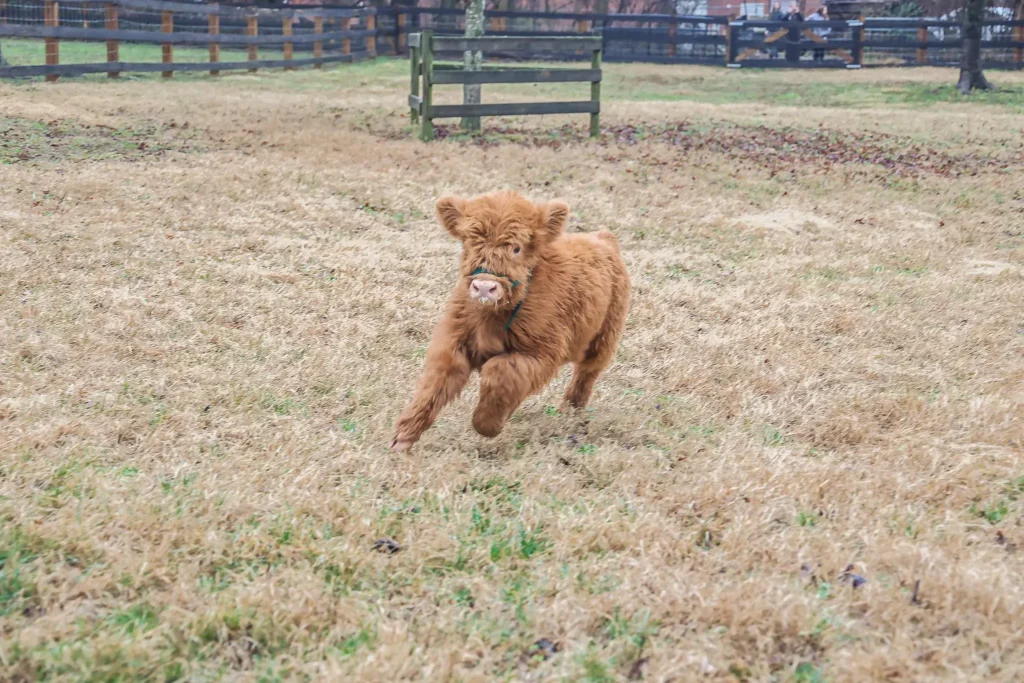
Weaning changes the calf’s life.
Before weaning, its mother provides a valuable source of energy and protein through milk. Once that milk disappears, the calf must get almost everything it needs from solid feed.
A small drop in growth rate can happen around this time.
The change can come from both diet and stress. The calf may be separated from its mother, moved to another field, mixed with different cattle, or introduced to a new feeding system at the same time.
Too many changes at once can make the adjustment harder.
A smoother weaning period usually starts before the calf is separated. It should already know how to eat good forage and drink water on its own.
After weaning, pay attention to:
- Body weight and steady gain
- Appetite
- Manure consistency
- Coughing or nasal discharge
- Signs of worms or other parasites
- Access to clean water
- Hay or pasture quality
- Mineral intake
Protein becomes important for muscle development, but energy matters just as much. Feeding plenty of protein without enough energy will not automatically produce good growth.
Young cattle also need minerals for bone and body development. Requirements change with the forage, soil, and local feeding system, so the mineral program should match the farm rather than following one universal mix.
Poor-quality winter hay can be a common reason for slower post-weaning growth.
A calf may seem to eat a lot but still receive limited energy if most of its diet is low-quality fiber.
Highland Calf Weight at 1 Year Old
By 12 months, a Highland calf may weigh somewhere around 220 to 320 kg, or about 485 to 705 pounds, under good growing conditions.
That is a wide range for a reason.
A pure Highland raised slowly on rough pasture should not be compared directly with an animal receiving richer feed. Genetics, birth month, sex, mothering ability, climate, and pasture season can all move yearling weight.
Highland cattle can reach around half their mother’s body weight during their first year under good conditions.
Imagine a mature Highland cow weighing around 500 kg. Half of that is about 250 kg. A healthy yearling near this weight would therefore fit well with normal breed growth.
Some yearlings will be heavier.
That does not automatically mean they are better cattle. Growth needs to match frame, structure, health, and the purpose of the animal.
A breeder raising future breeding cattle may prefer steady frame development rather than pushing very fast weight gain.
A beef producer may watch daily gain and feed efficiency more closely.
Yearling weight is also influenced by what happened several months earlier. Illness at four months, poor milk production, heavy parasites, or a difficult weaning period may still show up on the scale at 12 months.
That is why keeping simple weight records from birth onward can be valuable.
Male vs Female Highland Calf Growth Rate
Bull calves usually grow larger and heavier than heifer calves as they get older.
The difference may be small at birth. One study of Highland calves found average birth weights around 25 kg for males and 24 kg for females.
As calves grow, male hormones and natural body structure can create a larger difference.
An intact bull develops more muscle, a heavier neck, thicker bone, and a larger overall frame. A heifer grows toward the smaller mature body size typical of Highland cows.
Adult size shows this difference clearly. Mature Highland bulls can reach around 800 kg, while mature cows often weigh around 500 kg under normal conditions.
Steers fall into another group.
A castrated male usually develops differently from an intact bull. He may not build the same heavy neck and masculine muscle, but he can still reach a good finished weight.
One cattle source notes that Highland steers can finish around 450 kg, with some reaching that size as long yearlings under heavy feeding while many pasture-based systems allow them more time.
Sex is not the only thing affecting growth, though.
A heifer from a strong growth line with a high-milking mother may easily outweigh a bull calf that had poor milk, worms, or low-quality pasture.
So it makes more sense to compare similar animals of the same age and management group.
Factors That Affect Highland Calf Growth
No single number controls how fast a Highland calf grows.
Growth comes from several things working together.
Genetics
Genetics sets much of the calf’s natural growth potential.
Some Highland families produce larger-framed cattle. Others remain smaller and mature slowly.
Traits related to birth weight, weaning weight, yearling weight, milk ability, feed efficiency, and post-weaning growth can all have a genetic part. Modern Highland breeding programs track several of these traits.
Choosing only the biggest bull is not always smart. Very high birth-weight genetics may increase calving problems.
Balanced genetics are more useful.
Mother’s Milk
During the first months, the cow has a huge effect on calf growth.
A healthy cow producing plenty of milk gives her calf a strong source of protein, fat, energy, vitamins, and water.
If milk supply is low, the calf may begin relying on grass earlier. Growth can slow if the pasture cannot make up the difference.
A mother’s milk contribution is important enough that cattle growth systems can estimate how much calf weaning weight comes from milk production.
Grass and Forage Quality
Highlands can make good use of rough land, but that does not mean nutrition stops mattering.
Better forage normally supports better growth.
Young leafy grass provides more useful nutrients than very mature, stemmy pasture. Hay can also vary greatly in quality.
A growing calf needs enough energy to maintain its body first. Only energy left after maintenance can support extra growth.
Parasites
Worms and other parasites can quietly reduce growth.
A calf may continue eating while gaining less weight than expected.
Other signs can include a rough coat, loose manure, poor body condition, weakness, or pale tissues around the eyes and mouth.
Parasite control should fit the area and farm system. Constantly treating cattle without knowing the local problem can also create drug resistance.
Disease
Sick calves use nutrients and energy to fight disease instead of building body tissue.
Pneumonia, severe diarrhea, infections, and long-lasting digestive problems can all reduce gain.
A calf that falls behind after illness may show some catch-up growth later once health and feeding improve.
Weather
Highland cattle handle cold climates very well because of their thick double coat.
Still, young calves need enough nutrition and shelter from extreme wet, wind, heat, or cold.
Maintaining body temperature costs energy. When environmental stress rises, less energy may remain available for growth. Studies of young calves have found environmental temperature can affect average daily gain.
Stress
Stress can temporarily reduce appetite and growth.
Common stressful events include transport, weaning, mixing unfamiliar cattle, sudden diet changes, or handling.
Keeping routines calm and avoiding several major changes at the same time can help young cattle adjust.
Water
Water does not add calories, but growth depends on it.
Calves need clean water even when they still drink milk.
After weaning, water becomes even more important because the rumen needs it to process dry feed and forage.
When Highland Calves Reach Full Size
A Highland calf does not finish growing at one year old.
Far from it.
Highlands are a slower-maturing cattle breed. Much of the obvious height and frame development occurs during the first two to three years, but animals can continue filling out after that.
The difference between a yearling and a mature Highland is easy to see. Mature cattle have much deeper bodies, heavier bones, larger horns, wider chests, and more muscle.
Official weight data for Highland bulls also show how much growth continues after the calf stage. Bulls presented at two years of age averaged about 597 kg in 2025, while three-year-old bulls averaged about 743 kg.
That is a gain of well over 100 kg between those age groups, although they are different animals rather than the same bulls weighed one year apart.
Adult size depends heavily on sex.
A mature Highland cow commonly weighs around 500 kg. Mature bulls can reach around 800 kg, with individual animals sometimes falling above or below those figures.
This slow development is important when looking at young Highland cattle.
A 12-month-old animal that looks narrow through the chest may still develop much more body depth. A young bull’s neck and shoulders will become heavier as he matures. A heifer also continues filling out before and after her first breeding age.
Horn growth changes the animal’s appearance too. Young Highlands can look small and calf-like for quite a while, then become much more impressive as the horns, body, and long coat develop.
How to Tell if a Highland Calf Is Growing Normally
Do not depend on age alone.
Look at the whole animal.
A normally growing calf should usually show steady progress in several areas. Its body weight should increase over time, even if the rate changes with the season. The animal should stay interested in feed and water, move normally, and remain alert.
Feel the body rather than trusting the Highland’s thick hair.
Check the ribs, spine, hips, shoulders, and loin. A thick winter coat can hide both weight loss and body condition problems.
Recording weights is even better.
You do not need to weigh the calf every day. Birth, three months, around six or seven months, weaning, and one year can already give you a useful growth picture.
You can then calculate daily gain between each stage.
For example:
Weight at 6 months – Birth weight = Total gain
Then:
Total gain ÷ Age in days = Average daily gain
A calf born at 25 kg and weighing 160 kg at 180 days has gained 135 kg.
135 ÷ 180 = 0.75 kg per day.
That gives a much clearer picture than simply saying the calf “looks small.”
Should You Try to Make Highland Calves Grow Faster?
Faster is not always better.
Good growth is useful, but Highland cattle do not need to compete with high-input commercial beef breeds.
Their strengths include hardiness, pasture use, easy calving, strong mothering ability, and the ability to perform in conditions where some other cattle need more support.
Trying to force extreme growth with too much rich feed can increase costs and may make animals overly fat.
A better goal is steady, healthy development.
Provide enough milk during early life, useful pasture, good hay when grass is poor, clean water, suitable minerals, health care, and protection from severe weather.
Then watch the calf rather than chasing one perfect number.
A healthy Highland calf raised on good pasture may grow very well without an aggressive feeding program. Pure Highland cattle in pasture systems have recorded gains around 0.75 kg per day, while calves under favorable conditions may reach around 0.8 to 1 kg per day.
That is already strong growth for this breed.
Final Thought
So, how fast do Highland cow calves grow? A healthy calf can often gain around 0.75 to 1 kg per day during good growing periods, but the rate changes with age, feed, milk supply, sex, weather, health, and genetics. Birth weights are usually moderate, and many calves reach roughly 220 to 320 kg by one year when conditions are good.
Do not worry if your Highland does not look fully grown at 12 or even 24 months. This breed takes its time. Focus on steady weight gain, good body condition, clean water, strong nutrition, and good health. A Highland calf that grows steadily rather than extremely fast can still develop into a large, strong adult.
I kept the ranges flexible because Highland growth can change a lot between pasture-based, hill, and higher-feed systems.